DON'T MAKE WAVES
In Quentin Tarantino's novelization of "Once Upon A Time… in Hollywood," the auteur/author laid down a detailed backstory for Sharon Tate, from obscure Texas to infamous tragedian.
A "silly comedy" is how QT summed up one of Tate's first roles — as a bitchin' beach babe named Malibu — in the 1967 bedromp "Don't Make Waves." The movie also starred Claudia Cardinale, Tony Curtis and muscleman Dave Draper (with a guest cameo by Mr. Magoo) in what was an attempt to cash in on the "waxploitation” Beach Party/Muscle Beach movies starring Frankie and Annette.
QT knows cinema: "Don't Make Waves" is silly and the comedy has layers, but it should be required viewing for all Malibu citizens, as there are recognizable places and even faces — and maybe a scary prophecy of what is coming this winter.
Modern Malibuites will find it comic when 1967 citizens cringe at the thought of paying $100,000 for oceanfront property. That $100,000 translates to 2026$1,000,000 or so in modern dollars — but still... "Don't Make Waves" is a screwball love triangle that is Malibucentric in a lot of ways, especially the ending, when a Biblical rainstorm liquefies the cliffs over PCH into goo, dislodges a precariously perched precipice palace, and sends it tumbling down PCH with its inhabitants tumbling along with it, hanging on for dear life.
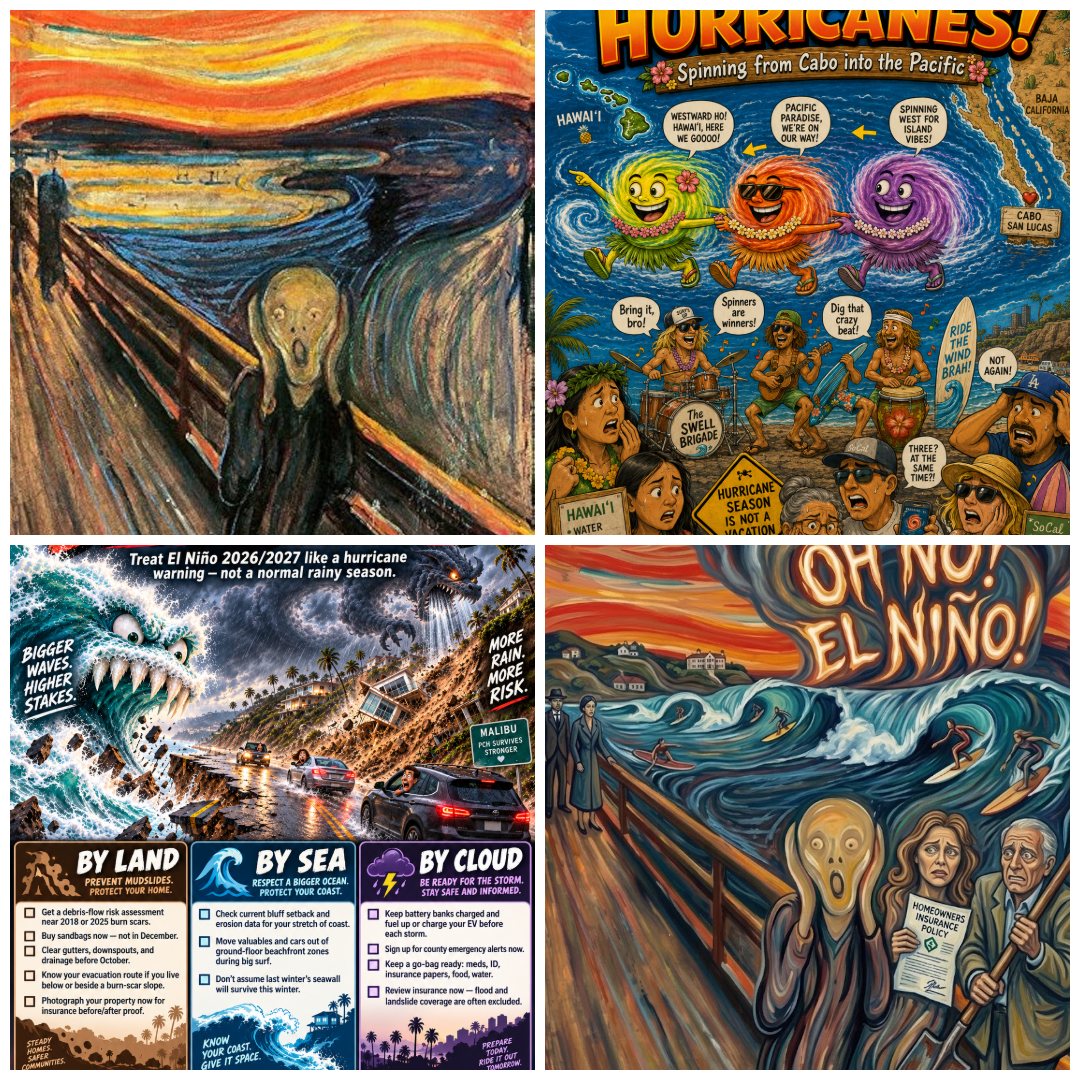
One man's comedy is another's threatening nightmare. By 1967 Malibu was known for a lot of things: surfers, Kennedy and Monroe, swimming fools, movie stars, earth, wind, fire and rain. Malibu has a long history of violent mudslides destroying houses, sparking lawsuits, killing people and blocking PCH. But what was comedy in 1967 is a looming tragedy for 2026/2027. With those unstable hills stripped bare by fire — exposed and vulnerable — there is a potential menace: a potentially record-breaking El Niño is bubbling over the horizon and along the equator right now. Something wicked this way comes, but it's too early to predict what effect this will have on the world, California, and specifically exposed, vulnerable Malibu — a quiet coastal community already plagued by veils of troubles.
PECULIAR THINGS
"I don't mind when peculiar things happen.
It's natural… because the world is a peculiar place."
- Michelle Pfeiffer as Sukie Ridgemont in Witches of Eastwick (1987)
Surfers are like Sukie character as they quietly cheer for peculiarities in the ocean and weather, because atmospheric and oceanic looniness can produce recreational and endorphinspiring opportunities for surfers and ocean people to get their fix and their kicks.
Meanwhile, Malibu homeowners clutching their pearls and insurance policies up in the vulnerable fire-stripped hills — or along a Pacific Coast Highway that's being gobbled up by the Pacific — are wondering just how bad this El Niño will be.
Who you gonna consult?
Mark Sponsler!
NorCalian Mark Sponsler (www.stormsurf.com) is the unofficial but respected/worshipped surf forecaster at Mavericks and points north. When I have questions about weather, the ocean, currents, trends, data, history, I go to Mark Sponsler. He knows his stuff, but is he educated or a hobbyist with PhD-level experiential insight?

"Yeah, I'm one of those surfers with a nerdy penchant for weather and specifically weather data and have been tracking surf-producing storms since 1967," Sponsler said. "I worked in the IT industry and used that knowledge to start Stormsurf in 1996, and haven't stopped since. If you are curious, and watch weather charts day after day and year after year, you'd be shocked at how much knowledge one can accumulate."
Which makes sense, because a lot of surfers who live and die by what the ocean is doing are tuned into buoy reports, swell direction, wind inputs, and know how to compute it, figure out what's coming, and drop everything — or at least had to before Surfline and all the surf forecasting websites did the thinking and prophesizing for us.
But because surfers are as weather-reliant-andtuned as farmers, pilots, fishermen, skiers and wildland firefighters, when know-nothing nabobs poo-poo climate change, global warming and sea level rise, I retort: "If you grew up on the Pacific Coast of North America — especially if you are a surfer, diver, sailboarder, standup paddler, foiler or sailor — and you know the ocean as well as you know yourself — there's no question things are screwy. And these changes aren't happening over centuries or millennia, they're happening year to year."
PIER KILLING SWELLS, WHITE SHARKS AND SEA TURTLES — OH MY!
How screwy? Well, Santa Cruz had two brutal back-to-back stormy winters that destroyed and/or badly damaged three landmark piers.
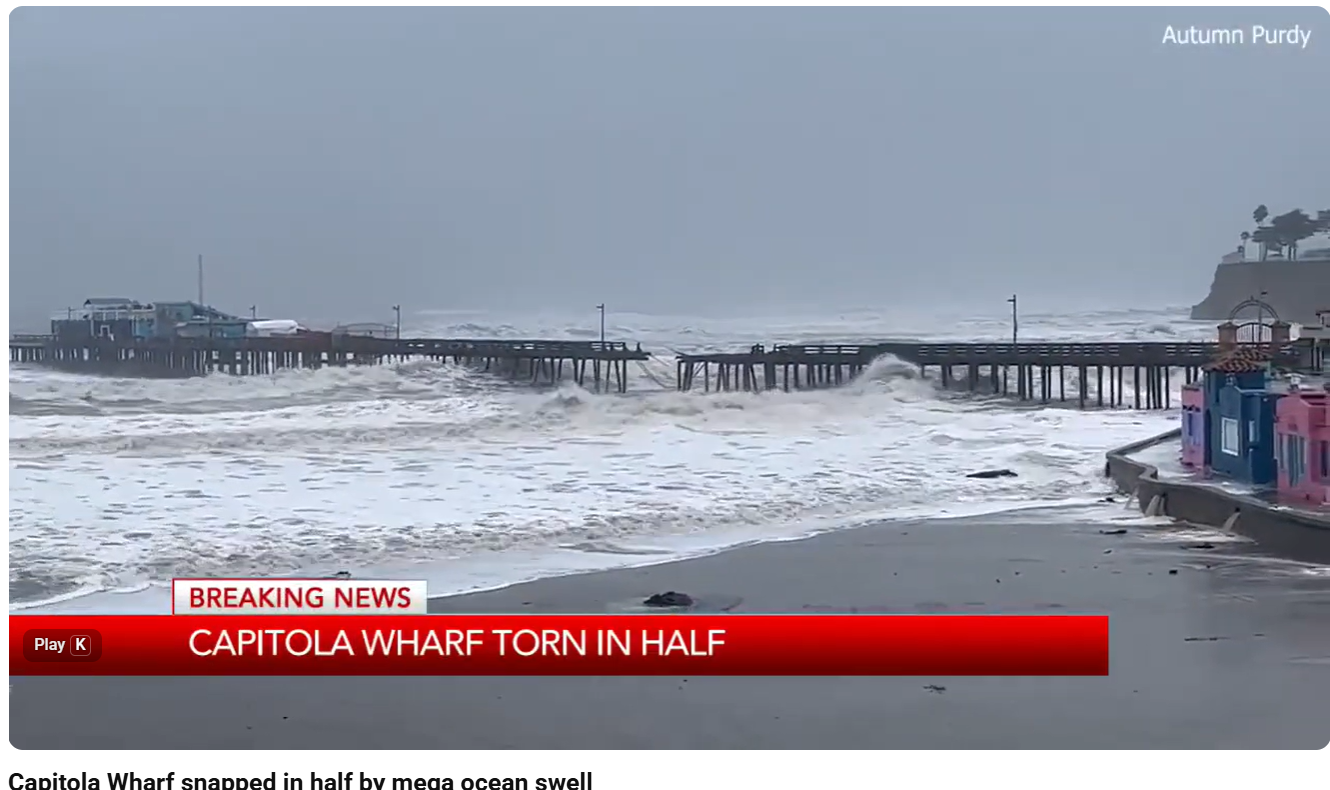
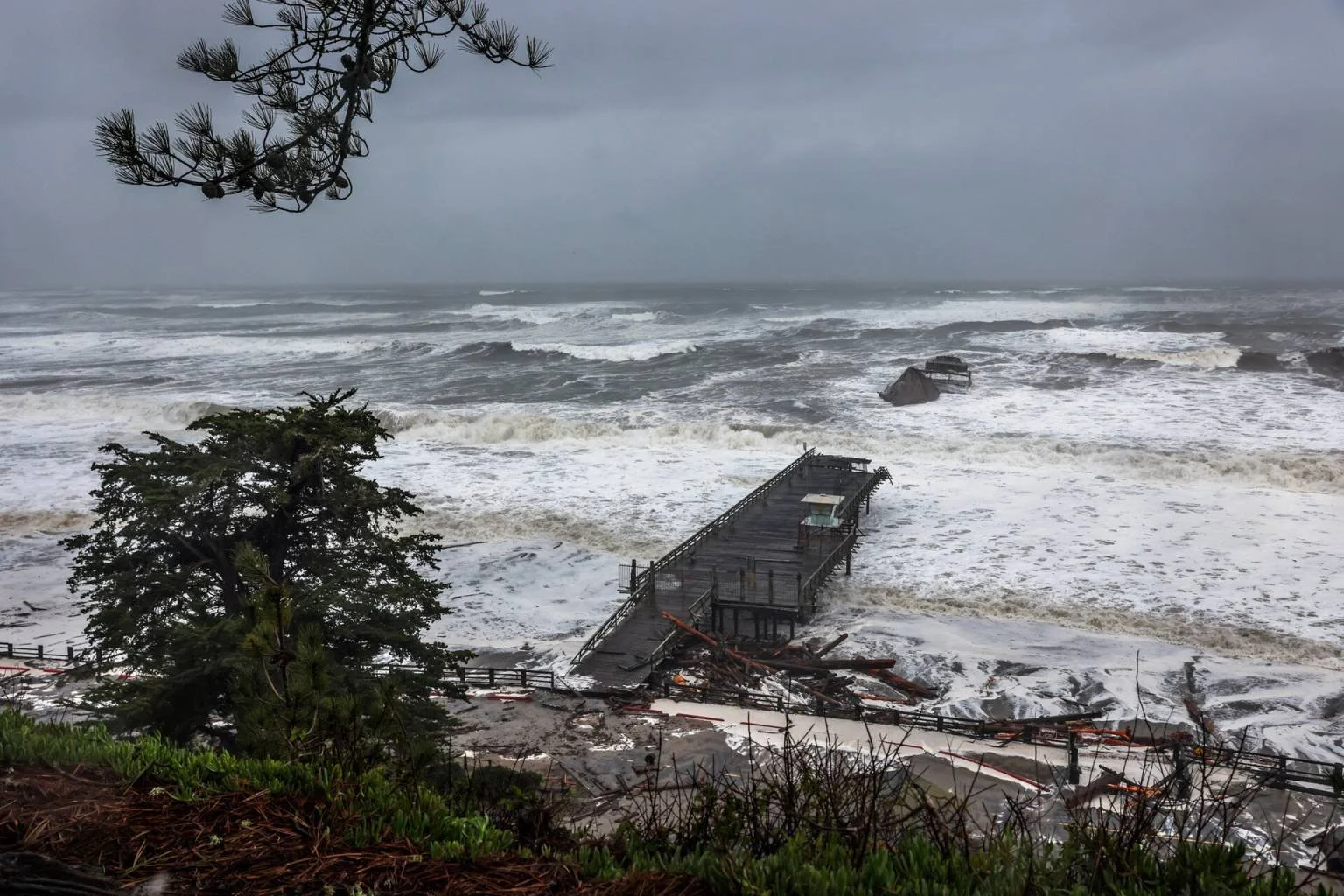
In January 2023, a bomb cyclone split the Capitola Wharf clean in half and finished off the historic pier at Seacliff State Beach that had connected the shore to the old cement ship, the SS Palo Alto, since 1930.
Then on December 23, 2024, one of the most powerful raw groundswells anyone had ever seen or surfed rolled through North Central California, creating a historic day at Mavericks — some are calling Luca Padua and Alo Slebir's wave that day the biggest ever surfed, with estimates near 80 feet.
"That day wasn't just huge," Luca said. "It was pumping. Nonstop, all day. That wave we caught, the wall went from the Marine Reserve to the Ritz Carlton."
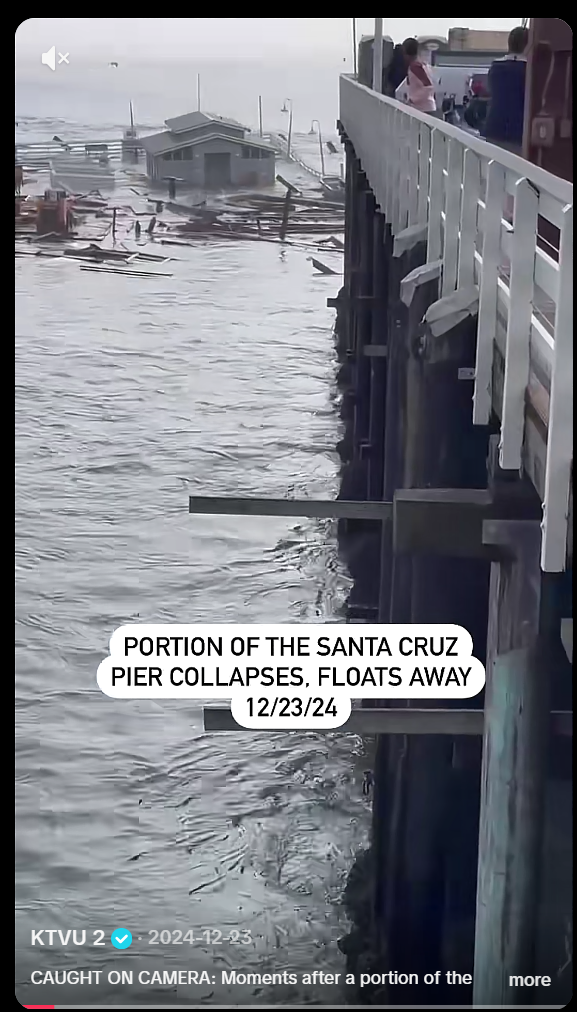
That same raw groundswell swept south and down into Monterey Bay, tore off a 150-foot chunk of the Santa Cruz Wharf, sank boats and wrecked docks in the upper harbor, and did damage officials compared to the 2011 Japan tsunami.
Raw, long-traveled North Pacific swell on a clear day. Not storm swell. Friends of mine who have lived in Santa Cruz all their lives and had seen it all had never seen its equal: a supercharged, wharf-collapsing, upper-harbor-invading swell.
But supercharged by what?
MALIBU PIER CLOSED AT THE END
Just weeks later, in January 2025, California State Parks quietly closed the end of Malibu Pier after its own structural assessment turned up concerning findings — and it's stayed closed ever since, with no repair timeline or funding source yet identified.
The Santa Cruz wharf collapse splashed two startled (and rescued) workers, some heavy equipment and a bathroom into the briny. But imagine if a beloved Malibu restaurant and gift shop full of people, and all those fishermen and kids, collapsed into the water all at once.
No bueno. Closed until further notice.
ROCKHOLD LOBSTER!
During the 1982/1983 El Niño, NorCal sport fishermen were jazzed/shocked to catch sailfish off the Farallon Islands, bonito in the San Francisco Bay and barracuda in Monterey Bay.
More recently, those screwy peculiarities some say are a myth may have caused other NorCal anomalies: Matt Rockhold, the Santa Cruz commercial fisherman and former pro surfer whose crab-trap TikToks have racked up over a million followers, was surprised and delighted to haul up a Pacific lobster in his trap.
He gave it a snack and dropped it back.
And on November 20, 2025, a green sea turtle — a species that has no business being anywhere near Monterey — was filmed cruising past Municipal Wharf No. 2 by local resident Rich Pena. Was Mr. Green an escapee from the Monterey Bay Aquarium? No, it was one very lost green sea turtle that followed the warm water north.
Execs from Disney tried to find the turtle to option its life rights, but it was gone.
White sharks prefer water temperatures between 50 and 60 degrees, and warming oceans might explain why there is now a “shiver” of 20 or more white sharks in the 13.5 miles between Moss Landing and New Brighton Beach in Monterey Bay — clearly visible with drones and from whale-watching and fishing boats.
In SoCal terms, that's the equivalent of 20+ white sharks clearly visible in the Santa Monica Bay in the 15 miles from Redondo Beach to Sunset — or how about 20+ white sharks lurking between Point Dume and Sunset?
Fun! Peculiar!
ARE GLOBAL WARMING AND CLIMATE CHANGE FOR REAL?
Asked for his experiential opinion on whether global warming and climate change are a clear and present danger, or the liberal-paranoid hysteria version of Chemtrails and 15 Minute Cities and UFOs, Sponsler didn't hedge: "I get asked this all the time — what evidence is there of global warming? The answer: there is a clear signal that the planet's oceans are warming, starting in the late 70s/early 80s.
"The oceans have warmed enough that today, what is considered normal water temps down in the equatorial Pacific would have been a minimal El Niño in 1980 (about 0.5 deg C or 0.9 deg F). NOAA established what was an average normal sea surface temp to then compare current temperature against, to then determine if El Niño or La Niña was developing.
"Both can dramatically affect our environment which has very real economic impacts, like variation in precipitation and its effect on crops and livestock. Water temps locally and its effect on fish stocks and commercial fishing. Snowfall and its effect on drinking water level and the recreation industry.
"El Niño and La Niña have a profound impact on humanity, and as the warming signal builds, the strength and duration of El Niños and La Niñas grows with it.
"Another signal is the retreat of glaciers. I'm no glacier expert though."
JUST WHEN YOU THINK YOU'VE SEEN IT ALL: NEPAL
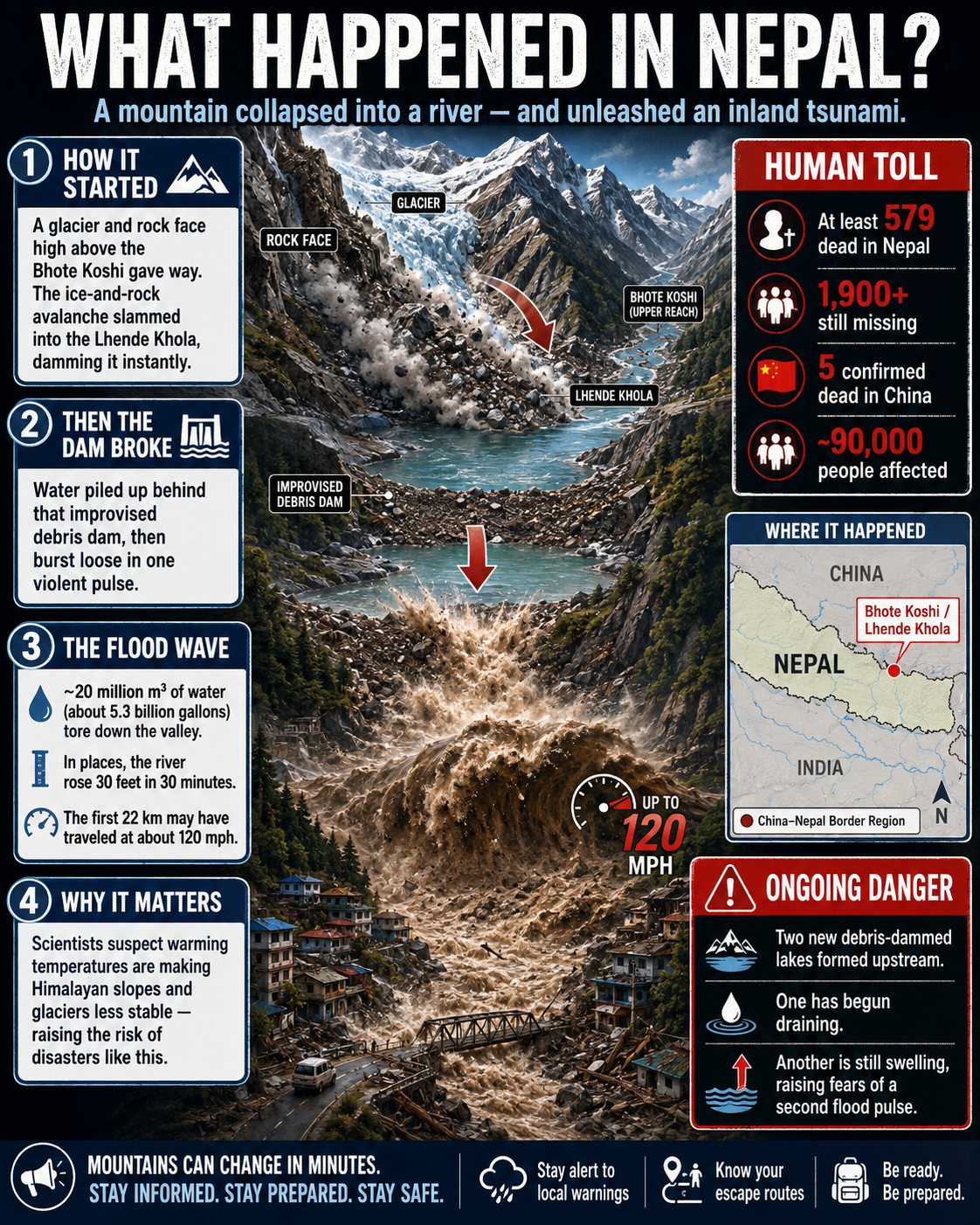
Glacial melt. Don't get me star'ed. On August 27, the world woke up to horrific disaster images scarcely to be credited: an inland tsunami careening down mountain river valleys, engulfing vehicles, homes, roads, entire villages. What looked like AI or CGI was disturbingly real. A glacier and rock face high above Nepal's Bhote Koshi river gave way — estimates vary from about 14 million to as much as 200 million cubic meters of rock and ice, weighing somewhere between roughly 32 million and half a billion metric tons — and the ice-and-rock avalanche slammed into a tributary called the Lhende Khola and dammed it on the spot. The water, ice and debris that piled up behind that new, improvised dam broke loose in a single violent pulse.
An estimated 20 million cubic meters of water — roughly 5.3 billion gallons, twice the capacity of Lake Hollywood and about 28 times the full original capacity of Malibu's own Rindge Dam — tore down the valley, raising the river 30 feet in half an hour and hitting a peak flow of nearly 1.5 million gallons per second downstream. A scientist at the Planetary Science Institute calculated that the wrong-way tsunami — a mix of water, pulverized ice, and rock — covered its first 22 kilometers at an average speed of 193 kilometers per hour, or about 120 mph, meaning it traveled nearly 14 miles in under seven minutes. It wasn't a lake bursting so much as a mountain collapsing into a river and letting go all at once — an inland tsunami.
As of Monday morning, August 31, the confirmed death toll stood at 919 (903 in Nepal, 16 in China), with more than 4,700 still missing (4,247 in Nepal, 546 in China) — including 592 foreign nationals, among them at least 85 Americans.
A stunning peculiarity of climate change and global warming? Maybe.
SOUTH OF THE POINT CONCEPTION LINE
Down below the Point Conception line, water temperatures have been running some of the warmest in Scripps Institution of Oceanography's 110-year record at La Jolla. On August 28, the Instagram channel us_stormwatch proclaimed: "SAN DIEGO COUNTY BUOY HITS 80°F, HISTORIC WARMTH FOR SOUTHERN CALIFORNIA WATERS" — a sea-surface reading of 80.2°F recorded less than 10 miles off San Onofre Beach, as a severe marine heatwave fuels historically humid conditions across SoCal this week.
People have long called San Onofre "the Waikiki of California," and 80-degree water helps that claim. In 2026 alone, 36 days between January and April set all-time highs for their calendar date.
Warmer water has been very good to Pacific bluefin this summer — the temperature breaks created where warm currents pushing up from Baja collide with the cooler California Current concentrate baitfish, and the bluefin follow them in closer to shore than usual. The numbers back it up: the Inter-American Tropical Tuna Commission raised bluefin catch limits by nearly 80 percent for the 2025–2026 season on the strength of the species' comeback, and in just the week ending July 26, 2026, California boats landed over 2,000 bluefin — the kind of volume anglers are calling the best SoCal bluefin fishing in 30 years. Yum. Bluefin taste good.
SNOW CRAB MELTED, SALMON SCRAMMED, DUNGENESS DELAYED
But warm water isn't a blessing everywhere. Ask Alaska's crab fishermen, California's salmon fleet, or the state's own Dungeness crabbers.
In the Bering Sea, more than 10 billion snow crabs vanished between 2018 and 2021 — an 84 percent population collapse — as marine heat waves spiked the crabs' metabolism just as warming disrupted their food web, and they essentially starved. Alaska canceled the snow crab harvest in 2022 and again in 2023 — the first cancellations in the fishery's history. Industry estimates put direct revenue losses as high as $500 million, with a more conservative federal tally at $287.7 million, and nearly 7,000 Alaska fishing jobs disappeared over those two years — hitting the town of St. Paul, home to the region's only crab processing plant, hard enough that it lost 60 percent of its municipal tax revenue and formally declared a cultural, economic and social emergency.
Closer to home, California's own salmon industry just came out of a brutal three-year stretch — commercial and recreational seasons shut down entirely in 2023 and 2024, with only six open recreational days in all of 2025, as drought and warming rivers hammered Sacramento and Klamath River Chinook runs. California's salmon industry is normally worth $1.4 billion in economic activity and 23,000 jobs a year; the 2023 closure alone is estimated to have cost $45–65 million, and recreational salmon trips collapsed from nearly 99,000 in 2022 to zero the following year, with roughly half the fishing fleet forced to take shore jobs, some of them for good. Federal disaster relief eventually covered $20.6 million of the losses — far short of what fishermen say they needed, and much of it arriving more than a year late. Some years, NOAA officials reported losing 90–95 percent of endangered winter-run Chinook eggs in the Sacramento because the water simply got too warm for them to survive. The season only reopened in 2026, after river conditions and dam removal finally allowed Chinook numbers to rebound.
Warm water has hit Dungeness crab too — fueling the harmful algal blooms that produce domoic acid, a neurotoxin that makes crab meat unsafe to eat. Northern California's commercial season was delayed into mid-January this past year over exactly that, and state officials are already bracing for a rough 2026–27 season, with one calling the developing domoic acid situation "a biggie" on par with a devastating bloom a decade ago.
So the same warm water padding bluefin trip logs from San Diego to the Bay Area is starving crabs in the Bering Sea, cooking salmon eggs in the Sacramento, and poisoning Dungeness crab meat. It depends entirely on which species, and which threshold, you're talking about.
MALIBU HAMMERHEAD
Around Malibu, a hammerhead shark cruising past the Malibu Pier on August 13, 2026 was the first sighting that close to Southern California beaches in over a decade. That certainly counts as alarmingly out of the ordinary, as does the ongoing coastal erosion that shut down Westward Beach Road indefinitely and is chewing away at the Malibu coastline like mice nibbling the wires on your Koenigsegg. The erosion has been made worse by the January 2025 Palisades Fire — many of the seawalls that used to buffer that stretch belonged to homes that burned down, leaving nothing between the surf and the bluffs.
Surfers delight. Homeowners fright.
NAZARE, MUNDAKA, MULLAGHMORE AND UNSTAD IN AUGUST?
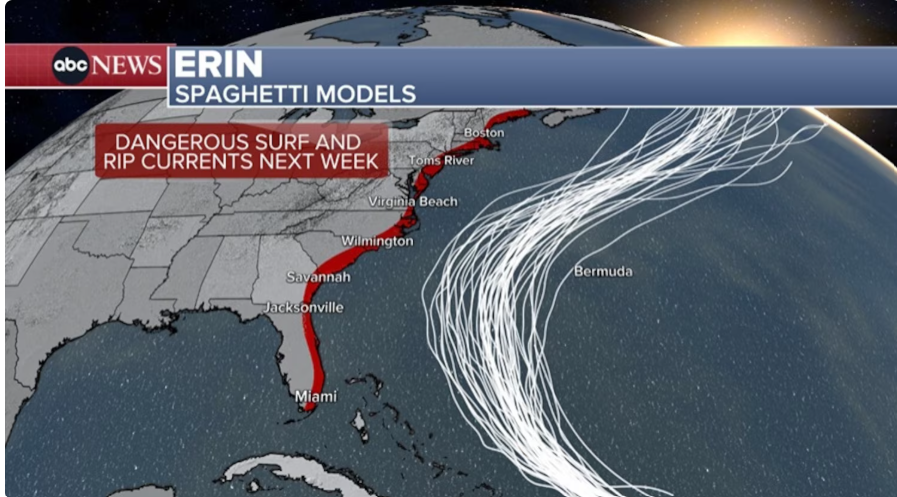
"Legendary" and "iconic" have joined the list of Most Annoying, Overused Words along with "Curated," "Artisanal" and "Cali." But those words applied to Hurricane Erin, the perfect wave-creating storm that spun up the middle of the Atlantic in August of 2025. The only part of it that touched land was perfect hurricane surf from Miami to Nahant to Maine. Then the lovely Erin turned east and created world-class surf from Nazaré in Portugal to Mundaka in the Basque Country and all the way up to Unstad, Norway — the same latitude as Barrow, Alaska.
Craig Sage, owner of Mundaka Surf Shop, said Mundaka was eight feet and grinding and broke 20 boards. In August. Unheard of.
Legendary! Iconic! Do it again!
MAVERICKS IN AUGUST?
So is anything wicked-cool like that coming to the Pacific for fall into winter? Mavericks in September? The Wedge in January? Sponsler says it doesn't look like it, yet: "I was thinking we'd have an early start to the winter surf season. Well no luck," Sponsler sighed. "Though El Niño is coupled with the atmosphere down on the equator, the jetstream in the North Pacific is sound asleep. So for all those tropical systems on the equator, there's literally nothing in place to force them to turn northeast and go extratropical while pushing east over the dateline. This is a complete reversal of what happened in '97. We got a large long-period swell in late September '97.
"Given where the jet is today, I'm not seeing that happening anytime soon. Very strange. The PDO (Pacific Decadal Oscillation) is also indicating a high-pressure regime over the North Pacific. Statistically speaking, that should not be happening."
MEANWHILE, IN THE ATLANTIC: THANKS, MR. PRESIDENT!
Erin was a one-off miracle. This year, the Atlantic hasn't produced anything worth talking about at all. As of 9/21/2-026, the basin has gone the entire season without a single hurricane — the longest wait for a first Atlantic hurricane in the satellite era, breaking the old record of September 11 (set in both 2002 and 2013). Six named storms have wandered through — Arthur, Bertha, Cristobal, Dolly, Edouard and, just recently, Fay — and not one of them has managed to spin up past tropical storm strength.
Has this ever happened before? Almost, but not quite like this. Since World War II, only two other seasons made it through the September peak without a hurricane: 1962 and 1994. Both went on to produce hurricanes anyway before the season ended. If 2026 finishes with zero hurricanes start to finish, it'll be only the third time that's ever happened in the entire modern hurricane record — joining 1914 and 1907. That's 112 years. Colorado State's Phil Klotzbach, who tracks Accumulated Cyclone Energy (a stat combining how many storms form, how strong they get, and how long they last), says this season is running at about 7 percent of a normal year's total — itself a record low going back to 1950.
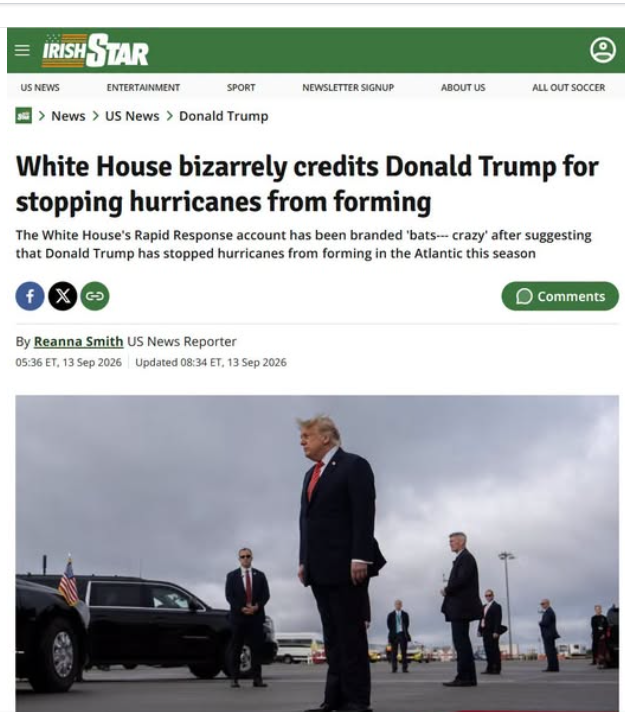
Naturally, somebody had to take credit. When meteorologist Chris Martz posted about the record-breaking drought and it went viral, the White House's own communications account swooped in and replied: "Thank you, President Trump!" — officially crediting the 47th president with personally shutting down Atlantic hurricane season, an achievement roughly on par with personally stopping the tide. It got picked up and mocked everywhere from the Daily Beast to LGBTQ Nation, and — this being 2026 — it also made the rounds on Facebook pages like Christina Aguayo News, presented with the kind of straight face usually reserved for miracle cures and Nigerian princes.
Here's the joke within the joke: the actual reason the Atlantic is a ghost town is the exact same beast this whole column is about. El Niño's wind shear is choking off hurricane formation over the tropical Atlantic, while that same El Niño pattern is the one about to turbocharge the East Pacific and, if Sponsler's right, dump a historic winter on Malibu's own backyard. Same El Niño, two oceans, opposite outcomes. So if you want to thank someone for the quiet Atlantic, thank a sea-surface-temperature anomaly out by the Galápagos, not the guy in the Rose Garden — and given how this winter is shaping up out here, "thanks, Trump" might turn out to be a joke that ages very badly, very locally, very soon.