
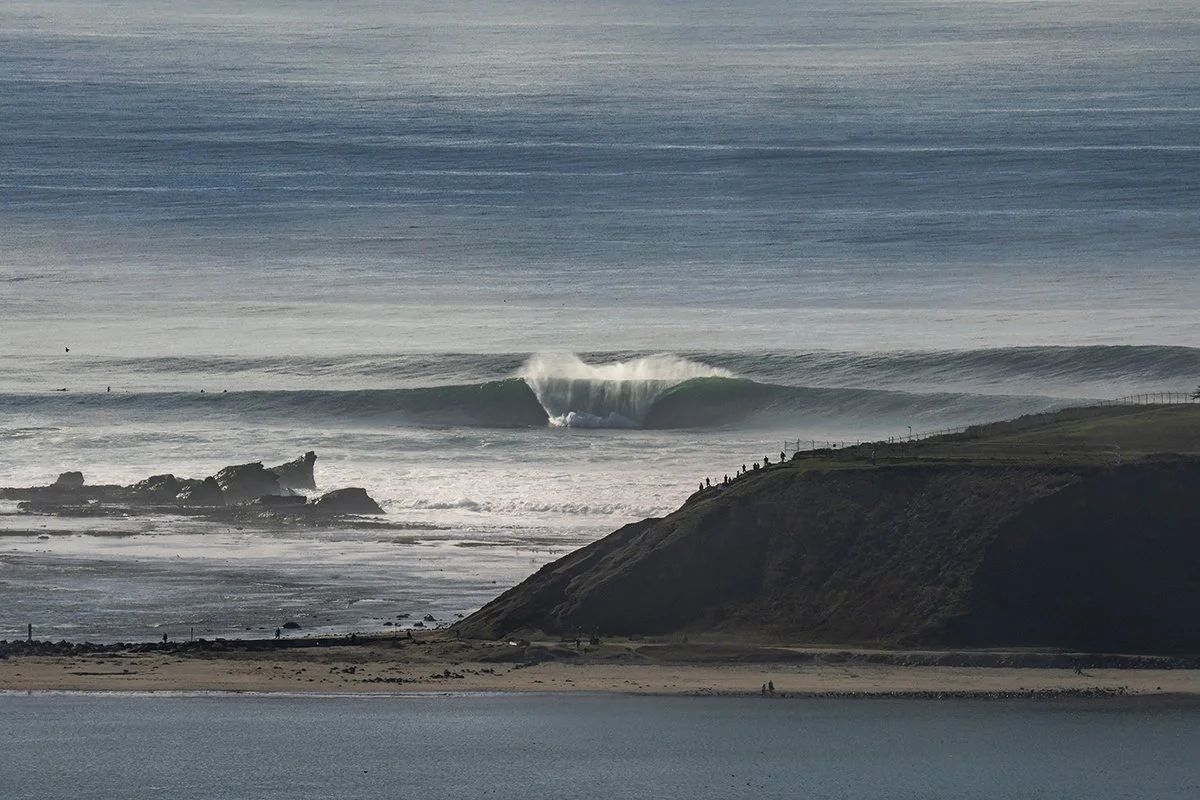
Mavericks, as seen from the hills of El Granada. Surfers often use explosive verbs and adjectives to describe breaking waves: “It was bombing!” “It was nuking!” “That wave exploded!”
Nearshore is about Mavericks, nuclear weapons, Tunitas Creek, Martin's Beach — which I've always called Bates Beach — sharks, steelhead, San Gregorio and Pescadero Creeks, Half Moon Bay Airport, fog, wind, currents, tides, and the whole juxtaposition of Pacific Ocean, Santa Cruz Mountains, and the population density and wealth of Silicon Valley and the Bay Area. I enjoyed Nearshore the same way I enjoy Steinbeck. He wrote about the Salinas Valley the way you write about Half Moon Bay: all familiar-like.
Honored to be compared to Steinbeck, but he's in an entirely different stratosphere.
Your book does the same thing for me with Half Moon Bay — a place I know well, since my dad lived in Moss Beach and El Granada for many years. That's actually why I wrote the first article on Mavericks.
That article was a groundbreaker. You deserve all the credit there.
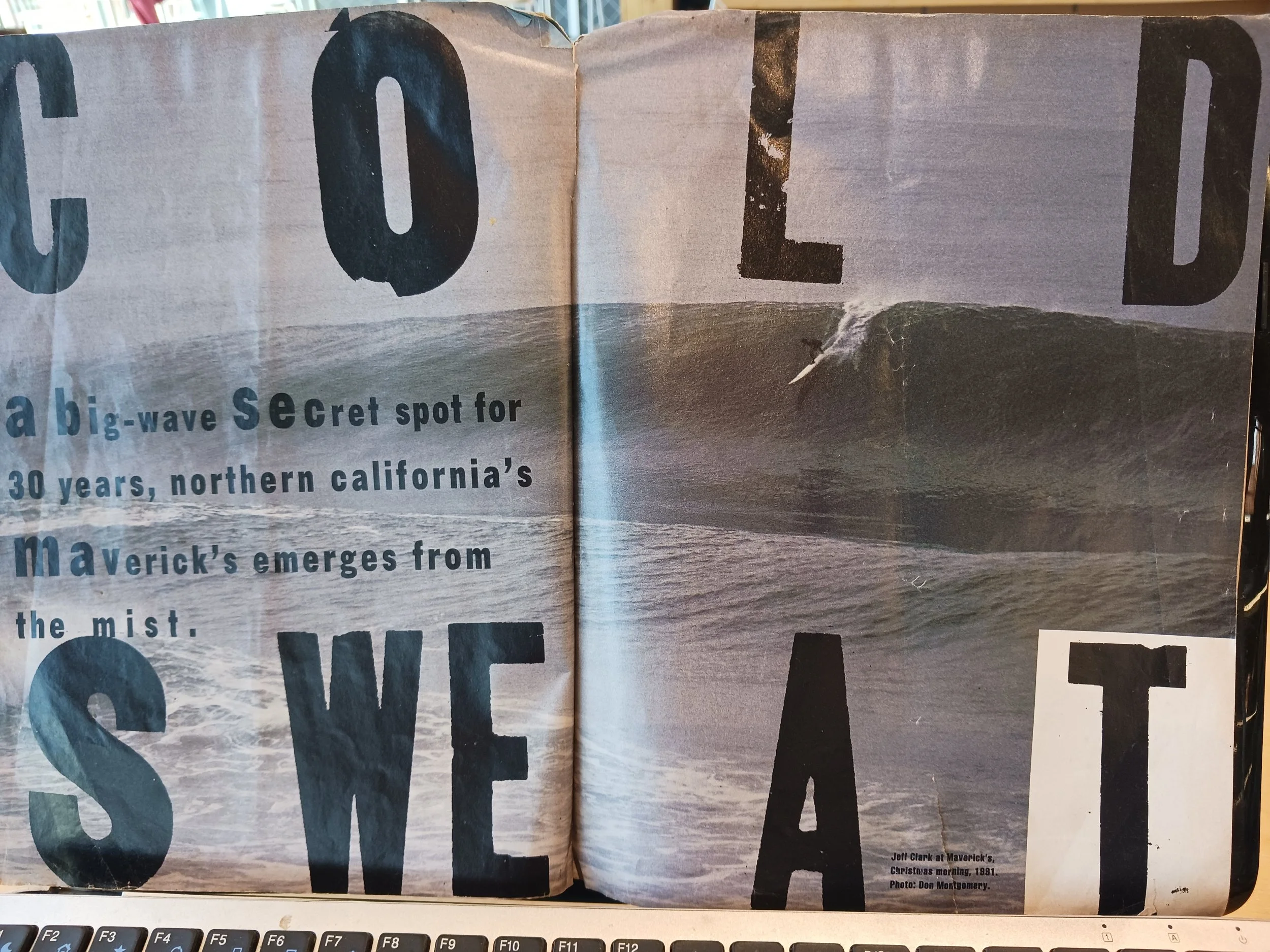
My story, your title, and a perfect one you absolutely nailed: Cold Sweat. Do you remember how that came to you?
No. You've credited me with that for years, but I'm not sure it was actually my idea. Are you sure it wasn't yours?
Now that I've thanked you, you thanked Harry Truman for greenlighting the Manhattan Project, because your father was a carrier-based fighter/bomber pilot in WWII and you might not have been born if Truman hadn't said, “Do it. Do it.” I always wondered why Uncle Sam didn't just light one off in Tokyo Bay and let the Japanese know: “Game over, man, GAME OVER.”
But even after Hiroshima, Japanese pride still wouldn't surrender, so three days later it was Nagasaki. Harsh.
There's actually a strong argument Truman didn't need to use the bomb at all — that he was too uninformed and timid to stop the military's plan already in motion. I recently read Alex Wellerstein's The Most Awful Responsibility, about Truman's decision to drop the bombs on Hiroshima and Nagasaki in August 1945. FDR died that April, and Truman didn't even know the Manhattan Project existed until he became president — he had four months to get up to speed on history's deadliest weapon, by which point the let's-nuke-Japan train had already left the station. He also didn't grasp how devastating it would be on civilians — melting eyeballs, flash burns, radiation sickness, all of it — until John Hersey's Hiroshima came out in 1946.
That's a newer version of history based on recent research. Growing up, I gave those two bombs credit for keeping my dad alive — if Japan hadn't surrendered, he'd have been part of the invading force, and the military was bracing for hundreds of thousands of American casualties.

Well, you can thank my ancestors for the Manhattan Project. My grandfather Clifton Tuttle and great-uncle Fordyce Tuttle both worked for Kodak. Grandpa Clifton set up the ultra-slow cameras that filmed the Trinity test. Fordyce was Director of Optical Physics for the National Defense Research Committee — might've been him who devised the lenses Fat Man and Little Boy used. These are my people.
It shouldn't surprise anyone who knows you that you come from a long line of brainiacs.
So — a novel. Got logline?
A lifeguard who's a former pro surfer stumbles upon a Silicon Valley billionaire's terrorist plot. Mayhem ensues.
You and I disagree about AI, so just to be a jerk, I was going to feed Claude your materials and have it spit out questions, then challenge you to figure out if it was me or Memorex. But then I saw the warning stamped on your watermarked PDF: These unpublished proofs may not be uploaded or ingested into any AI system under any circumstances. So I guess I'm just gonna have to read it myself and ask intelligent questions.
Glad to hear it. ChatGPT might end up being the death of all artistic thought and effort. Please stop using it. If you don't use your creative brain muscles, they atrophy. Nearshore is a 300-page, 70,000-word book — the thing I'm most proud of in my career — and I had zero help from AI. Took five years, but worth it.
Some backstory: describe your life up to this point in 50 words or less.
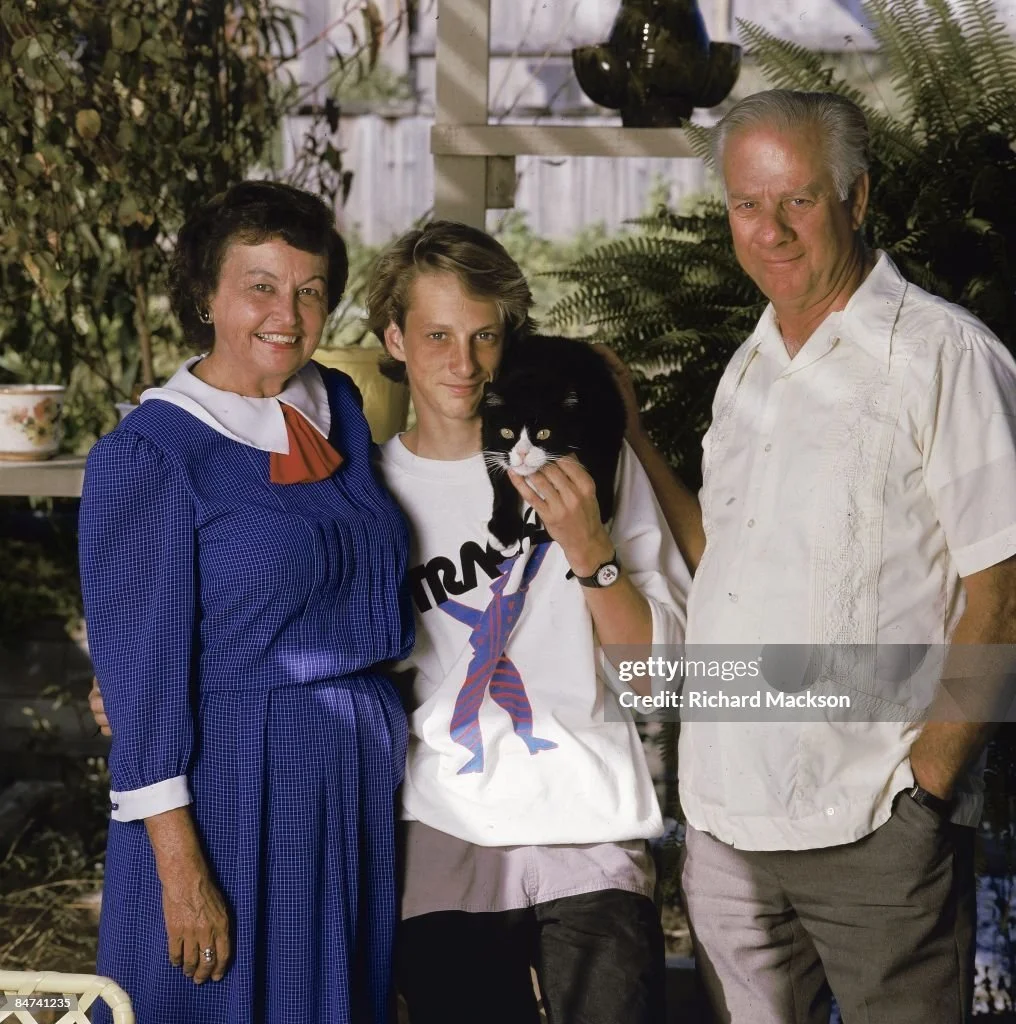
Grew up in San Diego. College at UC Santa Barbara. Newspaper reporter for ten years, editor of SURFER for eight. Also edited surfline.com, Sierra, and Stanford Business mags. Wrote for a TV show. In Half Moon Bay since 2000. Wife, two sons. Gave Tony Hawk his first skateboard. Still surfing. That's 50 words exactly.
And where did the lightbulb for Nearshore first flash?
Nearshore's genesis dates back to surf sessions I had along the Northern California coast while working as an editor at the Stanford Graduate School of Business. My job there was translating dense scholastic research into palatable advice for execs, so I became an armchair expert on arcane topics like auction theory and computational linguistics. After work I'd drive from Palo Alto straight to Half Moon Bay and rinse off the day in the ocean. I thought it would be interesting to do something creative with that clash: the linguistic brain versus the sublingual brain.
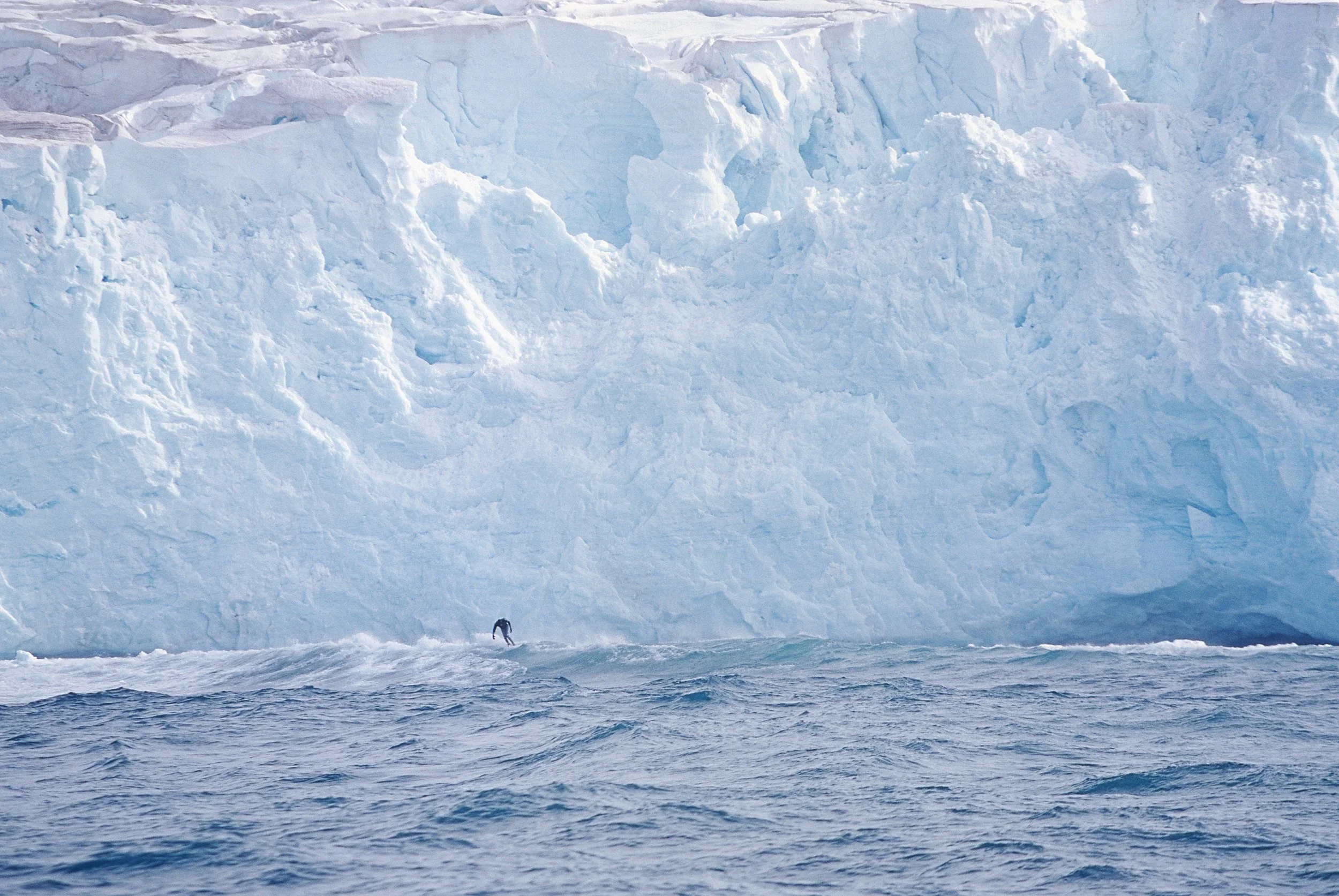
Cold water, big surf, frigid waters, collapsing glaciers, leopard seals: Steve Hawk hitting The Reset Button hard on a surf trip to Antarctica in February of 2001.
Yes — I call surfing “The Reset Button.” Cold water, big surf, an environment where humans aren't the apex predator. Exertion, cold, adrenaline, endorphins. A cranial palate cleanser. Exorciser of free radicals. Part of why I've written so many books.
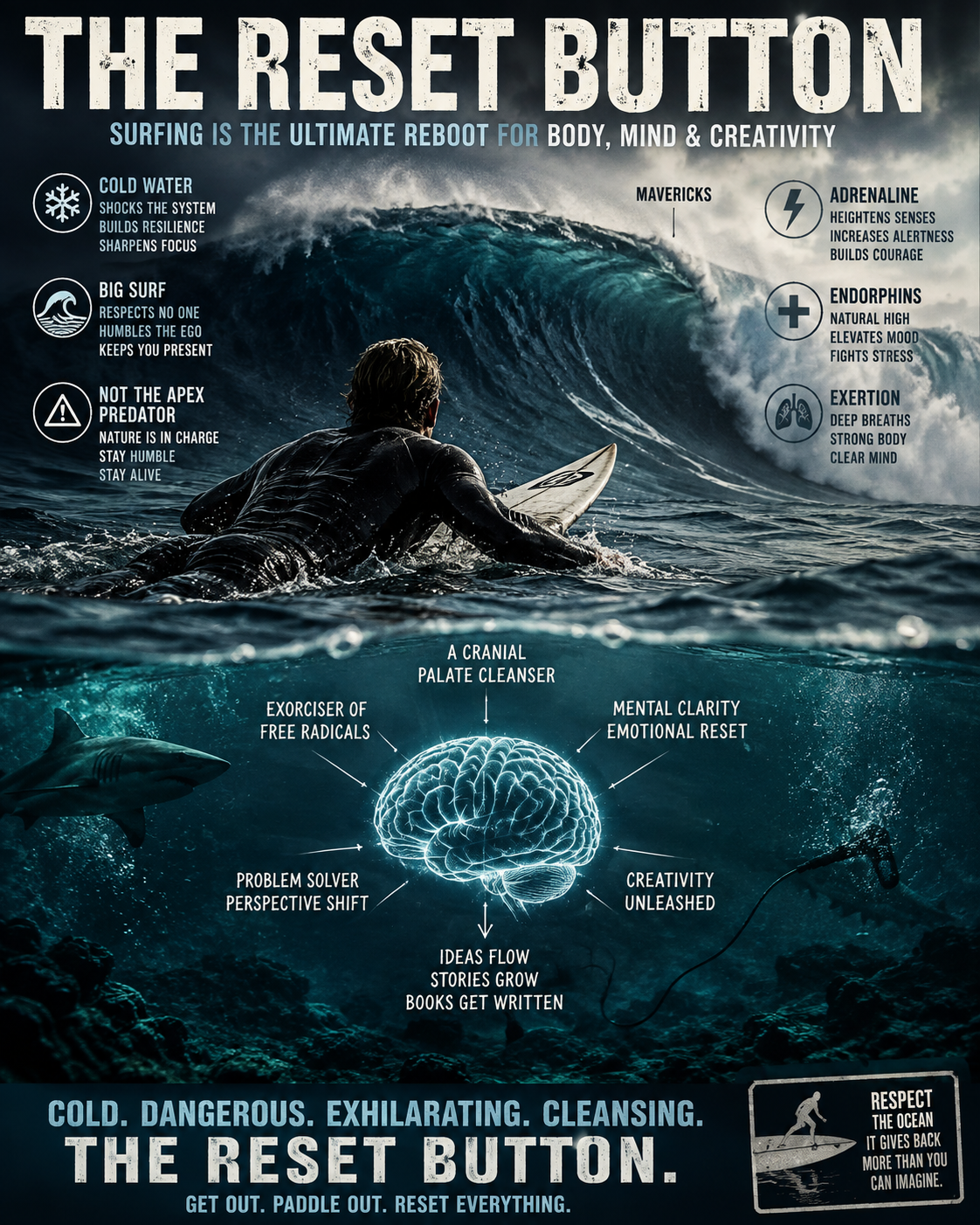
Exactly. That's the main reason surfing remains central to my life. I'm also interested in how the sea interacts with land along the wild coast where I live, and in the skill it takes to navigate nearshore waters — words are worthless in the wave zone, so describing that talent is a real challenge. Because of my time at Stanford, I was also fascinated by the dark side of Silicon Valley's reckless billionaires increasingly encroaching on the beaches I love. I asked myself: what's the most reckless thing one of those narcissistic geniuses could do? The answer seemed obvious. They'd build nukes.
When you mention Tunitas Creek, you could've used Jeff Clark's line: “We call that place Don't Eat Us Creek!” Also — you're exposing Don't Eat Us Creek to the WORLD, dude. Is that responsible?
They just opened a big parking lot above Tunitas, with a paved, ADA-certified trail to the beach. No Tunitas locals yet, but there might be soon. Also, the shark threat there is overblown — there are much sharkier spots nearby.
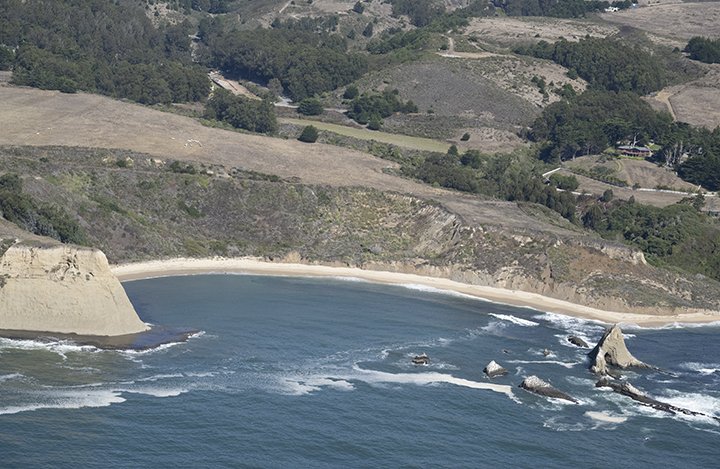
Tunitas Creek looks good from far but is far from good. Not the great surf spot it could be. Photo: CaliforniaCoastline.org
Reading now. Okay the narrator is the main character, Palmer - a surfer and lifeguard, a job that is serious business in California Weapons training, etc.
Palmer calls Daly City “the last place in the world I'd want to live in or be from — all those ticky-tacky houses, the rust stains on the stucco.” Those houses are all going for a million bucks plus now!
What kind of universe is this?
They used to have to PAY people to live in Daly City.
I lifted “ticky tacky” from Malvina Reynolds' 1967 protest song “Little Boxes,” inspired by those cookie-cutter Daly City houses.
TICKY TACKY HOUSES, BUILT IN THE 1950S, $1,000,000+++!!!!
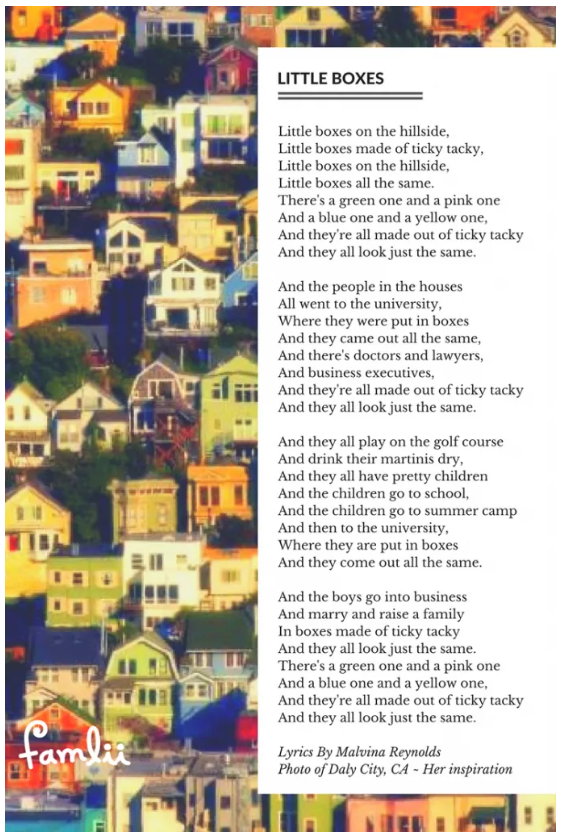
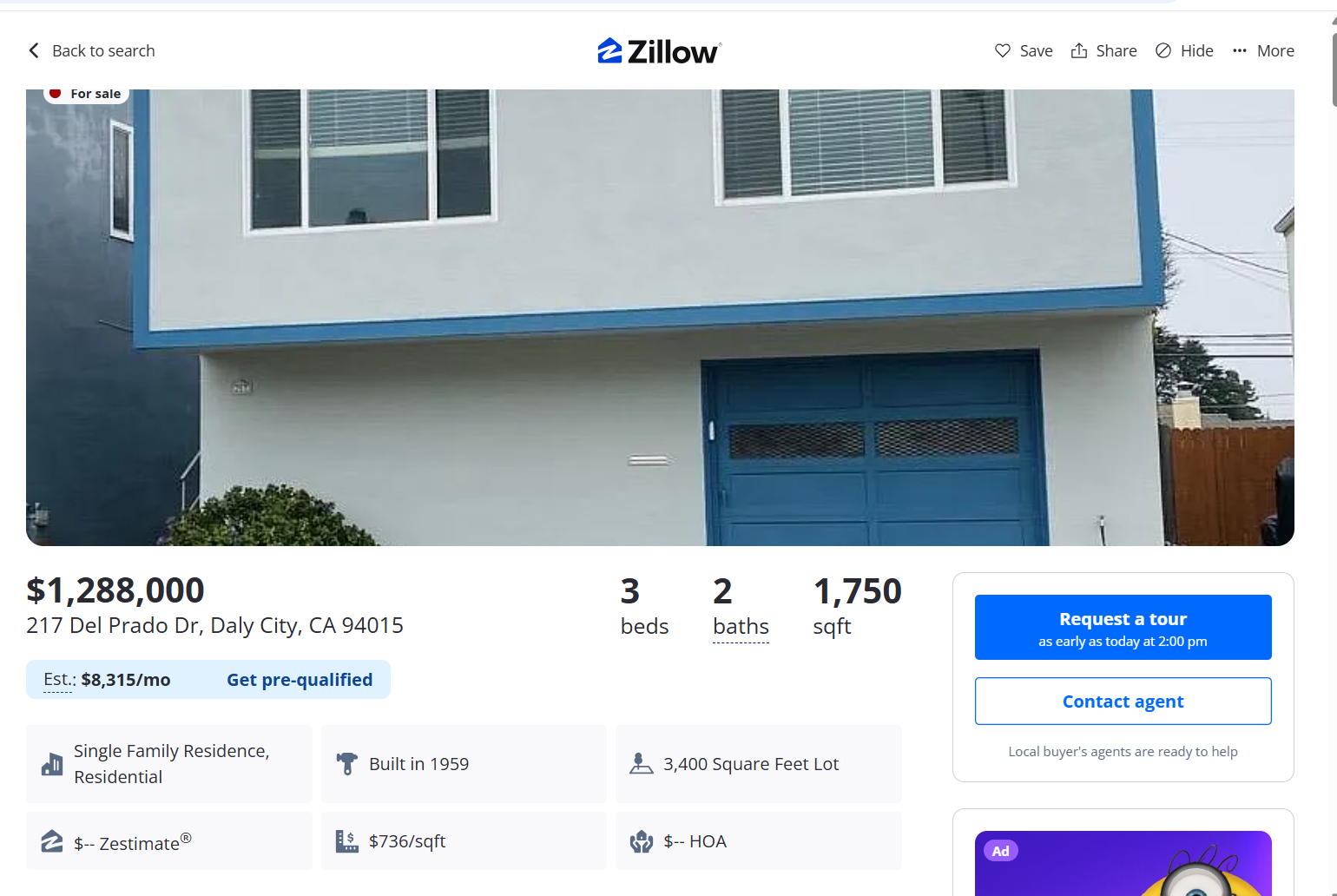



Wonder what she'd think about them now they're seven figures. In Malibu I met a guy named Moore who lives on a property on Pescadero Road his family has owned since like 1835. Is he of the Moore's Law line? He doesn't like his gazillionaire neighbors.
No, that's from Gordon Moore, co-founder of Intel and an OG Silicon Valley mogul — the guy who figured out that computer chips double in capacity about every two years with almost no increase in cost. I've heard he used to have a house on the beach at Davenport Landing.
I'm in two class-action lawsuits against AI companies for uploading books without permission. I wrote two surf guides but didn't put my name on them, so now I have to prove I wrote them. Could be worth money.
Do you see the grotesque hypocrisy of that? You're suing AI companies for stealing your stuff while praising AI for helping you write — built on stuff stolen from other writers.
I just wanna get PAID, bro! Anthropic has to pay $3,000 each for 500,000 other kiped books. There's another suit I'm in involving maybe 15 of my books.
Reading: I caught your use of the word “scree” and because I have a very strange literary memory, I accuse you of kiping that from Dave Parmenter's Alaska travel piece in SURFER.
Good catch. That word stuck with me from Dave's 1992 article about the first major surf trip to Alaska — still my favorite surf-travel story ever — and I've used it a few times since. There's another quote from that same Parmenter piece later in Nearshore.
IF THEY DROPPED A 100 MEGATON NUCLEAR WEAPON ON DALY CITY
From: https://nuclearsecrecy.com/nukemap/
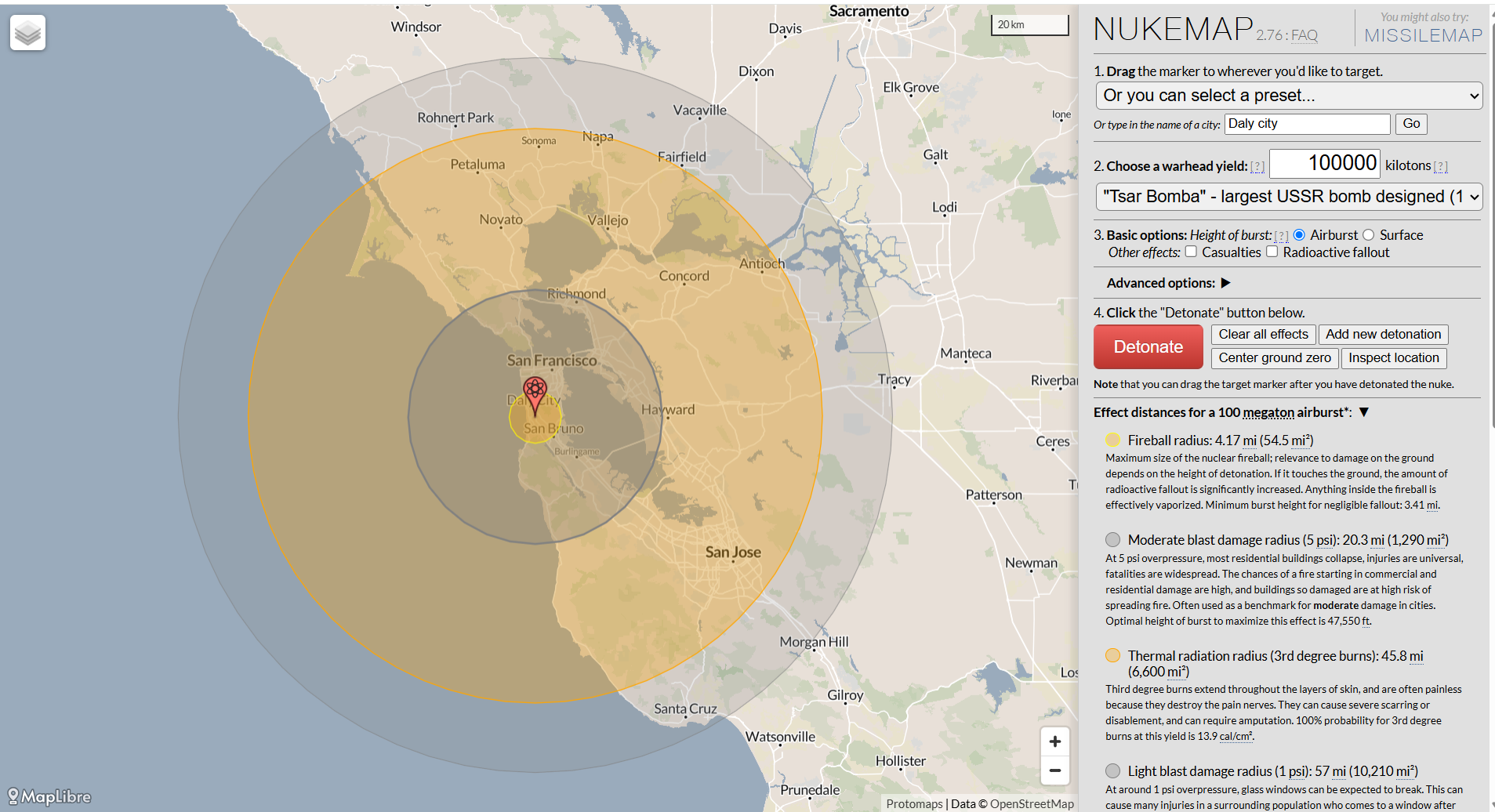
Did any nuclear experts vet this? Could these acts of nuclear terrorism actually be done?
I talked to a bunch: Alex Wellerstein (check out his nukemap site — it'll scare the shit out of you), Richard Rhodes (Pulitzer for The Making of the Atomic Bomb), Jeffrey Lewis (a non-proliferation scholar at Stanford, lives in HMB, became a friend), and Craig Marianno, a radiation-detection expert at Texas A&M. The last three read and vetted the book. It was Wellerstein who came up with the bad guys building their own uranium-enrichment plant — probably the scariest thing in the book, because it's genuinely plausible.
That could be part of the unspoken fear of Iran's nuclear program. If Iran even pointed a nuclear weapon at Israel or Uncle Sam, it'd be “Bomb bomb bomb, bomb bomb Iran. Game over, man. GAME OVER!!!”
But if a bit of that enriched uranium got into the wrong terrorist hands…
Uranium-enrichment centrifuges get more efficient and cheaper every year, and the only reason there's never been an act of nuclear terrorism is that the fissile material — enriched uranium or plutonium — is so hard to make. The bombs themselves, the mechanism that triggers the chain reaction, are relatively easy, and the details are pretty much public record now.
I fished Yellowstone with a retired FBI agent who said he'd gone to Russia as part of a NEST team and extracted a suitcase nuke being sold on the black market, probably headed for Iraq. I asked him the yield. “Two kilotons.” I asked what would happen if you put it at the base of the TransAmerica Building and pushed the button. He knew exactly — devastating from Tiburon across to Berkeley and well into Silicon Valley.
As I write in the book, it'd be way more devastating detonated in the air, from a plane, directly above the target city. That's what we did at Hiroshima and Nagasaki.
So I wondered how a golf-ball-sized chunk of enriched uranium could be that destructive. Right after that fishing trip I visited my friend Guzzy in San Jose — his wife's father was Elmar Zeitler, an expert in electron microscopy who nearly won a Nobel for developing the scanning electron microscope. I asked one of the top physicists in the world how something that small holds that much energy. He sketched fission out on paper. I still don't get it. How does that much energy fit in something so small?
It goes back to Einstein's E=MC². There's so much energy bound in an atom that converting mass to energy multiplies it by an unfathomable number — the speed of light times itself. In The Curve of Binding Energy, John McPhee noted the total matter converted to energy in the Hiroshima blast was about one-third the size of a penny. A 2015 Bulletin of Atomic Scientists piece put it even finer: of the 64 kilograms of uranium in that bomb, less than one kilogram underwent fission — and the entire explosion's energy came from just over half a gram of matter converted to energy. About the weight of a butterfly. That's why nukes are so scary.
Spooky. My Grandpa Clifton talked about witnessing Trinity — said it's one thing to know on paper what the bombs do, another to be seven miles out in a bunker feeling the concussion and heat and watching the mushroom cloud: “What have we done??!?!”
A lot of people who've witnessed nuke tests also say they're the prettiest things they've ever seen.
Part of the plot of Nearshore is sparking enough fear to repeal the 22nd Amendment and make the sitting president a President for Life — scary thought. Who are your bad guys modeled after?
For the billionaire, I took the worst aspects of the ugliest American billionaires — the ones journalist Gil Duran dubbed “The Nerd Reich” — and built a kind of Frankenstein monster out of them. His motivation is replacing American democracy with a theocratic authoritarian regime. His security guy, who recruits the bombmakers, just wants to blow shit up.
Some men just want to see the world burn. On page 191 you claim John John Florence is the best surfer alive, probably the best all-around surfer ever. But Kelly just competed at the Outerknown Teahupo'o event at age 54 — ate shit twice in his second heat, once feet-first over the falls in the lip, could've been badly hurt, brushed it off and almost scored a 20. Two giant barrels at 53. Unprecedented. Think John John will be doing that at 53?
Good point. Kelly is surfing's GOAT — you simply can't argue with that. But my perspective and my characters' perspectives don't always align. Also: I do love watching me some John John and some Caity.
Did you really see steelhead in a tributary of Pescadero Creek? San Gregorio? Hard to imagine those rivers were once chockablock with salmonids, like the Smith up north. I hate dead rivers.
Yes, I did. They're actually coming back. It's a rare environmental win.
Sounds like you took a few flights out of HMB Airport to get the bird's-eye view your characters see.
Yes — flew up and down the coast a couple times with my friend Dell Outman, a Southwest pilot who keeps a small plane at HMB Airport. Dell was huge — almost all the flying detail in Nearshore, including my own dad's WWII planes woven into the story, came from him.
They're gonna use the Half Moon Bay Air Show as cover??!?! That's evil!!!

Is Conrad based on Spencer Croul? All the warplanes are a tipoff — his dad has a P-38, a P-51, and a P-47 Thunderbolt.
I don’t know who Spencer Croul is.
Spencer Croul is one of the co-founders of the Surfing Heritage and Culture Center. His father, Jack Croul, sold Behr Paint for a gazillion dollars and collects warbirds: a P-51D called Miss Torque — Phil Roberts did a naughty nose art — a P-38 Lightning called Honey Bunny, a P-47 Thunderbolt called Dottie Mae, and they are about to unveil an F6F Hellcat, name unknown at this time.
What did your dad fly, and off of what carrier?
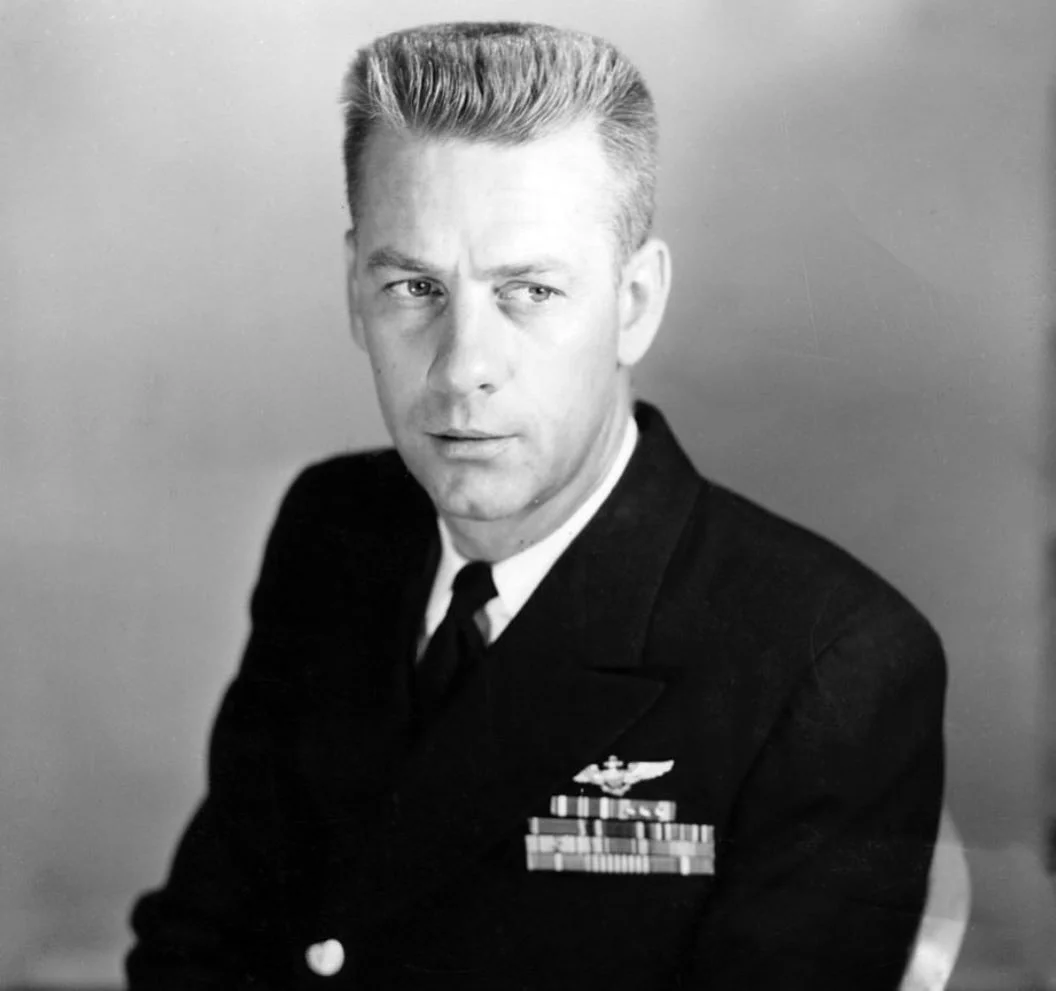
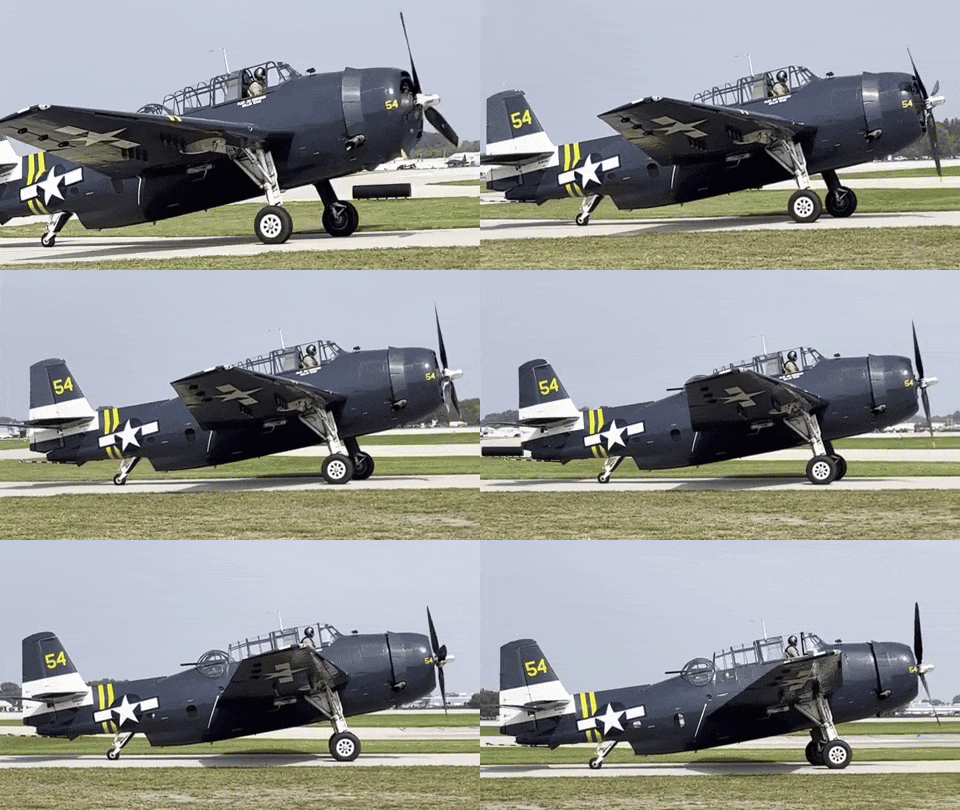
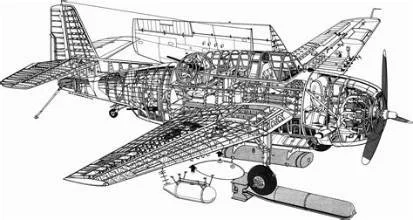
He flew TBM Avengers off the USS Chenango (CVE-28). Everything about Conrad's dad is lifted straight from my own dad's story, including his courtship with my mom.
CAPTAIN FRANK HAWK (1923 - 1995)

Reading along, for a moment I thought they were going to nuke the Farallones. That would make a statement but take out a lot of innocent abalone, urchins, and white sharks. Would've been cooler if they'd taken the bad guy out there instead, hung him off a winch and cut his throat — let him thrash around, maybe attract a shark, settle Asher's morbid curiosity about blood versus movement.
I've been out to the Farallones twice with Scot Anderson and Paul Kanive of the California White Shark Project — they say white sharks around here go almost exclusively for the scent of marine mammals, not human blood. The human-blood thing is a myth, at least out here.
Is there really a surf spot called Bone Machine? Kind of sounds like _______
No, it's fictitious. There are no rideable waves between Martin's and Tunitas. I made that up.
I always called Martin's Beach “Bates Beach” — always felt creepy.
Martin's is one of the spookiest places I've ever surfed. Feels super sharky.
Page 286 — “good's,” as in “that course made good's as reliable as they come”?
That's on purpose — a contraction for “good is.” One thing you might not have noticed: every one of Palmer's first-person monologue chapters has zero commas in it, to keep it conversational. Fun exercise.
The PQ code they discover reads like the AF code that exposed Japan's Midway attack — did I mention my grandfather helped crack that code? I’m sure I did. Was PQ a play on AF?
No. PQ stands for Pomona Queen, the name of the Lancaster bomber in the book — an homage to my friend Kem Nunn, who wrote a novel with that title.
I've traded emails with Andy Weir, the guy who wrote The Martian and Project Hail Mary. He was mentioned on Jeopardy! and wasn't aware — I sent him the clip. I could see your book taking off like that, easily. It plays right into the current paranoia over Iran's nuclear ambitions and Trump running for a third term, installing himself as President for Life like some raggedy-ass banana republic dictator. And it's pretty topical right now: billionaires doing bad things to install an autocratic regime here in America.
Admit it, you've already cast this in your head — who do you see as Palmer, Luca, Mason, Archer, and the rest?
No idea.
I'll have you know, this weekly Entertainment Column for the Malibu Times is read very closely by big shots from one end of Malibu to the other and around the world: Steven! JC! Sir Christopher (CBE 2019)! Mel! QT! Guillermo! Sir Ridley (GBE 2024)!
Hook us up!
Ten percent! When you win the Oscar for Best Screenplay, who do you thank first?
There's almost no chance they'll hire me to write the screenplay if it gets optioned. But if such a thing were ever to happen, I'd thank my wife, Pamm, for her saintly patience over the past 36 years.
Yeah, they'll probably have Claude AI write the screenplay. Faster. Less expensive. No drama.
I'll drop a nuke on anyone who does that.