
CALIFORNIA IS BEAUTIFUL, FERTILE AND RICH
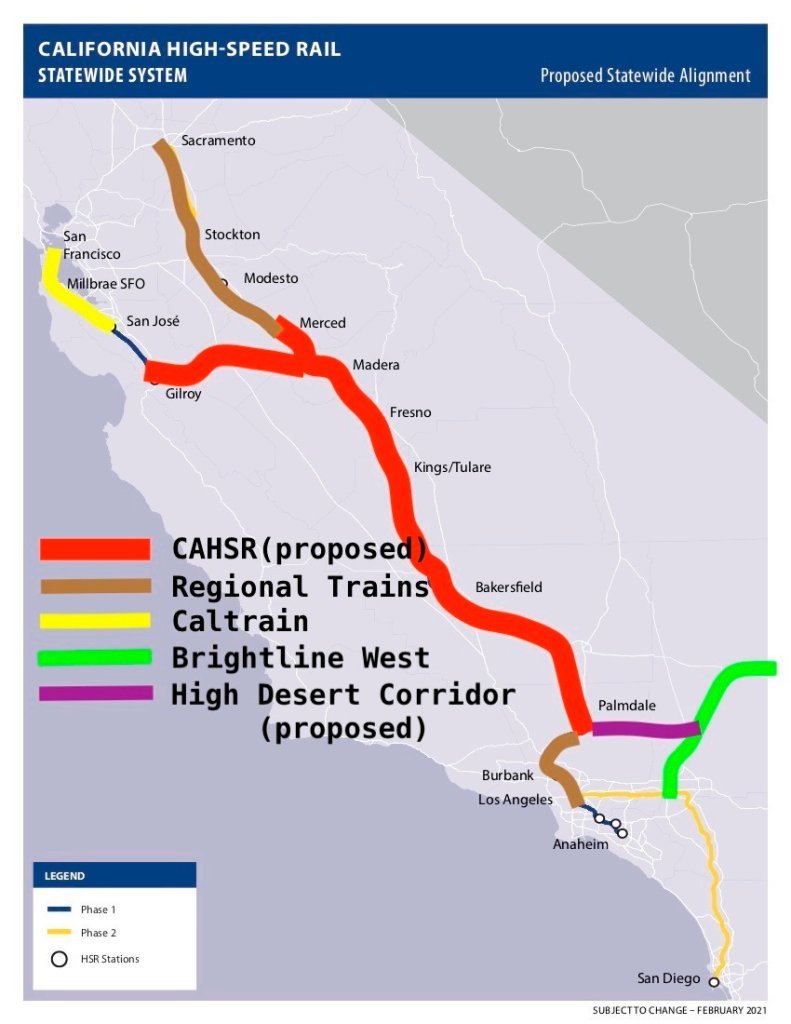
Up in Santa Cruz in early June, before the south swell hit and while my usually faithful Ford Expedition was in the shop, I rode with Randy French on a two-day trip to the far east: from Santa Cruz through Watsonville and the Pajaro Valley, through the Coast Range, past a reassuringly brimming San Luis Reservoir and across the Sea of Fertility — aka the San Joaquin Valley — to Mariposa, gateway to Yosemite, in the Sierra Foothills.
Along the way that mantra swirled — California is beautiful, fertile and RICH — as I am always astounded by the massive productivity of the Golden State.
We saw miles and miles of strawberries, raspberries, lettuce, artichokes (yum), broccoli and Brussels sprouts (yuck), tomatoes, melons, cotton, garlic, wheat, alfalfa, carrots, almond and walnut orchards, with apricots, peaches and nectarines filling in around Merced.
Despite the evidence of eyes, the #1 agricultural product of California is dairy, dotting the flatlands around Los Banos, fed by silage corn and irrigation water from the San Luis Reservoir.
Fun fact: Harris Ranch is that massive 120,000-head feedlot at the junction of the 5 and 198 — the road to Kelly Slater's Surf Ranch (which KSWCO have sold, apparently). Harris Ranch produces 200 million pounds of beef a year — 547,945 pounds every single day. Animal rights activists call it "Cowschwitz." When you're fiending for In-N-Out, that's Harris Ranch beef you're fiending for.
The smell and sight of that feedlot isn’t beautiful, but Harris Ranch is further proof that California is fertile and RICH!
From Bakersfield to Redding, the Central Valley runs roughly 400 miles in a straight line, 20 to 70 miles wide between the Coast Ranges and the Sierra Nevada foothills — roughly 18,000-20,000 square miles, producing $45-50 billion a year from relentlessly fertile farmland worth $10,000 to $60,000 per acre depending on water access.
Nearly every acre is already spoken for, economically productive, and valuable to someone.
A BIPARTISAN BOONDOGGLE
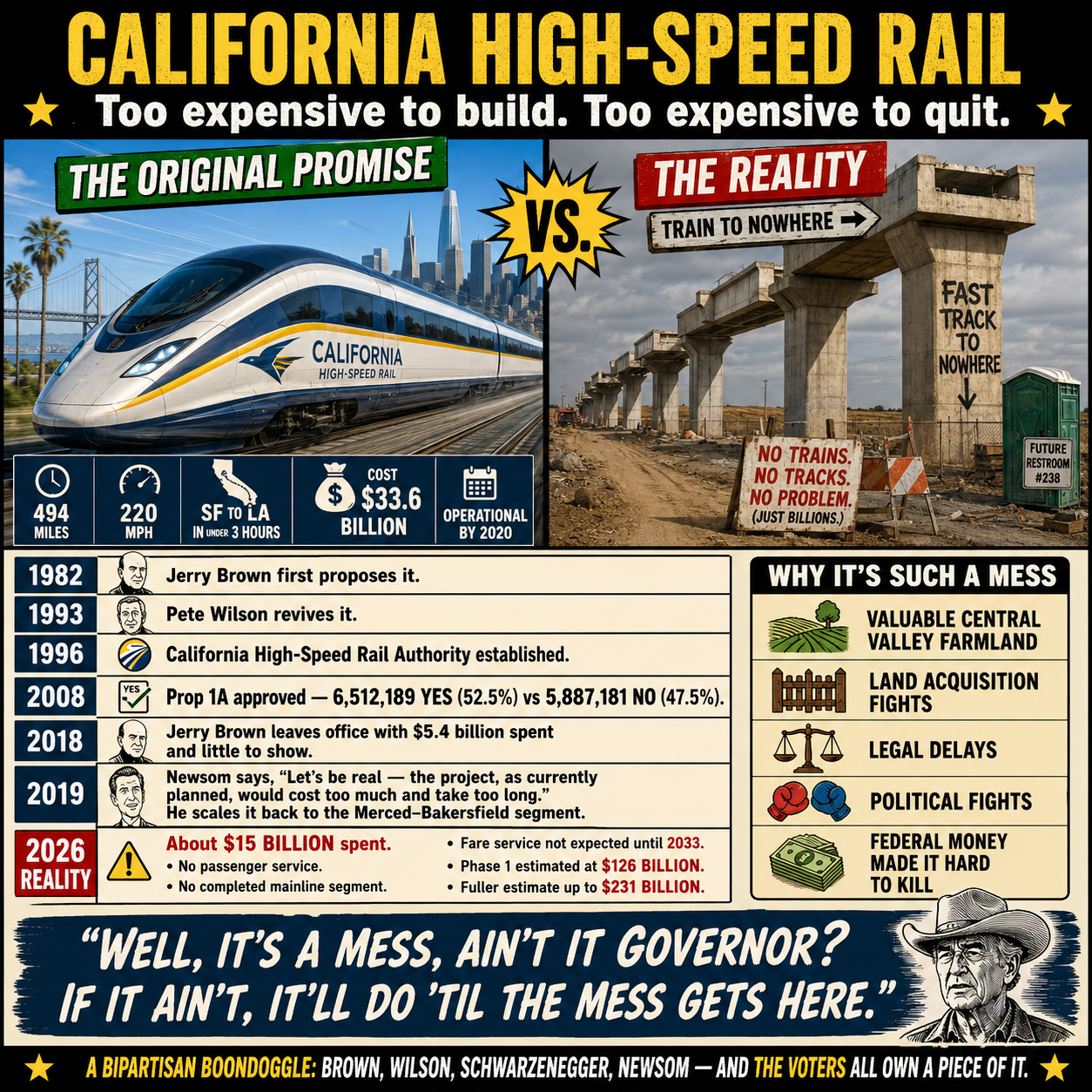
California is beautiful, fertile and RICH — but almost all of it is being utilized, so whoever thought it would be a cakewalk to lay hundreds of miles of high-tech, high-speed rail tracks, stations, maintenance yards, access roads, and utility corridors across that landscape without running into enormous land costs, legal, and political obstacles was way over their heads in high-apple-pie-in-the-sky hopes.
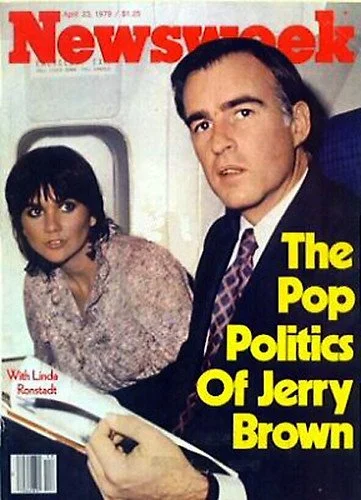
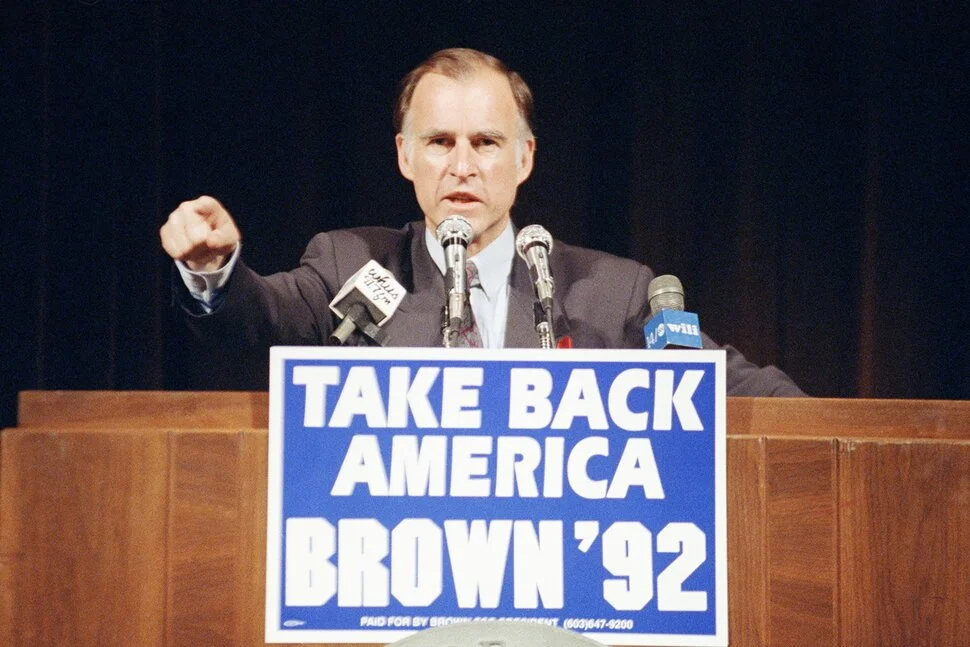
While Newsom and Jerry Brown are being blamed for what some online wags called the Dumbocrat Boondoggle Train to Nowhere, this is a Bipartisan Boondoggle. The story goes back to 1982, when Governor Jerry Brown first proposed it, signing a bill authorizing $1.25 billion (roughly $4 billion today) in bonds for an LA-to-SF line. It died due to dodgy ridership projections — California had 15 million fewer people in 1982 — and political squabbling.
A decade later, Republican Governor Pete Wilson revived it, creating the High-Speed Rail Commission in 1993 and signing the bill establishing the California High-Speed Rail Authority in 1996 — projecting the whole system, San Diego to Sacramento, for $18.18 billion ($36 billion today), done by 2008.
Not!
Then Republican Governor Arnold Schwarzenegger put Proposition 1A on the 2008 ballot, promising a 494-mile SF-to-LA train at 220 mph, under three hours, $33.6 billion ($49 billion today), operational by 2020.
Cal-ee-forn-knee-yuh voters approved Proposition 1A — barely: 6,512,189 Yes (52.5%) vs. 5,887,181 No (47.5%). A margin of 625,000 votes on what became one of the most expensive infrastructure disasters in American history.
As late as 2010, the Japanese government made California an offer they shouldn't — in retrospect — have refused. Japan offered to finance the whole thing with low-interest loans, provided California use Shinkansen technology. California said いいえ、結構です — "no thank you" — and decided to do it their own way.
(A Friend Who Wishes to Remain Anonymous believes the Japanese offer was refused because Japan would have demanded strict financial oversight and would not have allowed the tremendous waste — and some say fraud — that have plagued the project ever since.)
WELL IT'S A MESS, AIN'T IT?
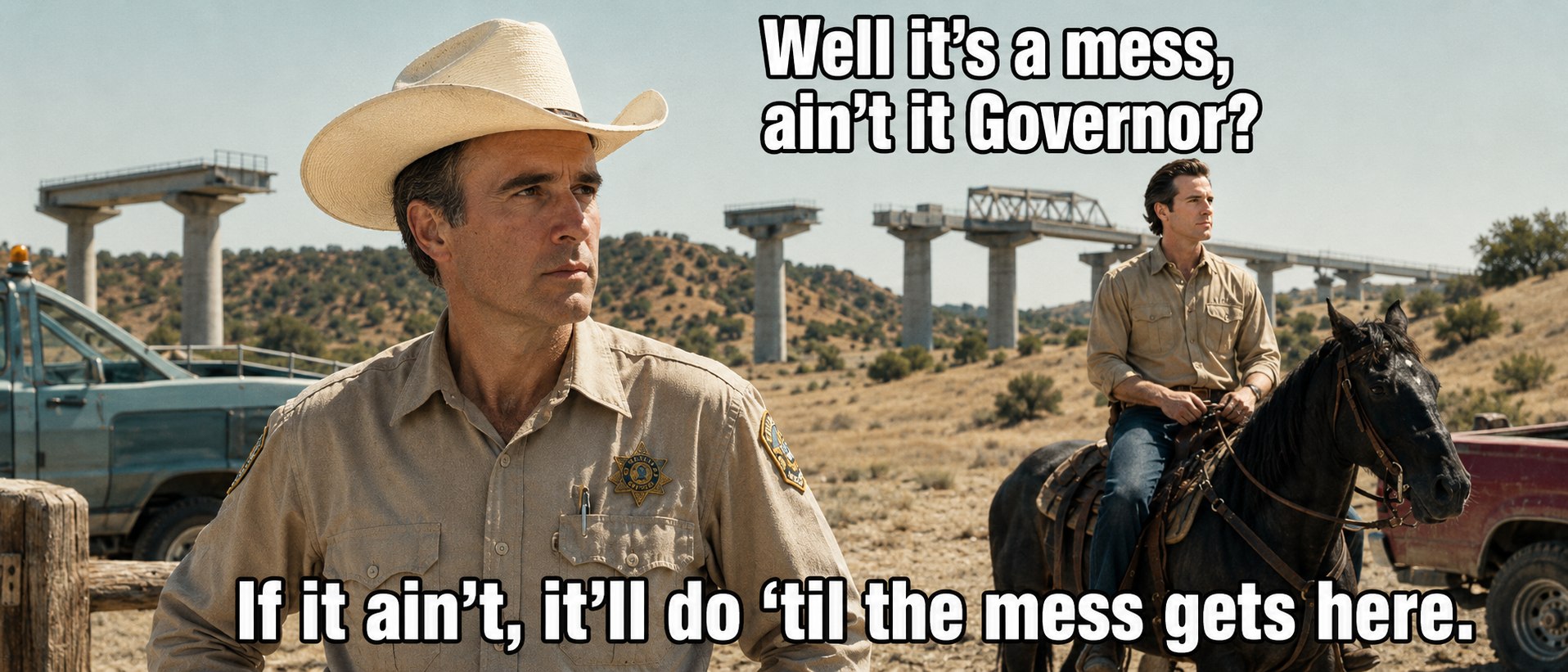
It's easy to think of Jerry Brown as Tommy Lee Jones' Sheriff Ed Tom Bell in "No Country for Old Men" and Gavin Newsom as the eager deputy Wendell riding alongside:
"Well it's a mess, ain't it Governor?"
"If it ain't, it'll do 'til the mess gets here."
Famously frugal as Governor, Brown drove a Plymouth Satellite and rented a modest apartment. But frugality aside, he returned as governor after 2011 and became the project's most stubborn defender — cheerleading it to the end as costs exploded and deadlines evaporated, leaving office in 2018 with $5.4 billion spent and very little to show for it.
HE DROVE A PLYMOUTH SATELLITE

Newsom came closest to rearing back on the brake lever, saying in his 2019 State of the State: "Let's be real — the project, as currently planned, would cost too much and take too long." He scaled it back to the Central Valley stub between Merced and Bakersfield. But when Trump moved to cancel $928 million in federal grants and claw back $2.5 billion already spent, Newsom dug in: "I am not interested in sending $3.5 billion in federal funding back to Donald Trump."
(And if you want to be mean, you have to ask: who is in a high-speed hurry to get to Bakersfield or Merced? Although on our trip we found Merced does have the epic Vallarta Supermercado, donde puedes conseguir todo lo que quieras. If you're passing through, don't pass it by.)
Neither governor could kill it because once federal money is in the mix, canceling means handing billions back to your political enemies with nothing to show for the billions already burned. The train became too expensive to build and too expensive to quit.
As they said in Brokeback Mountain: "HOW CAN I QUIT YOU!!!?"
STONEHENGE
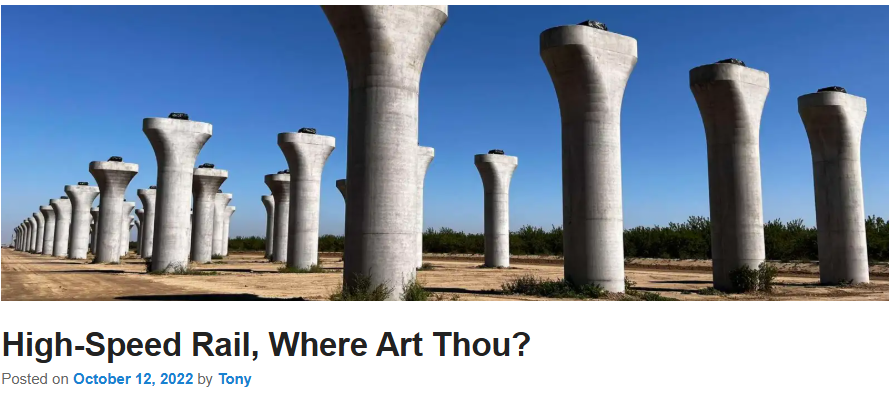
Eighteen years and $15 billion later, what exists in the San Joaquin Valley is still closer to a skeleton than a transportation system — miles of guideway, viaducts, overcrossings, and concrete structures dubbed "Stonehenge" by critics, looking about as sad and expensively hopeless as the burnout lots along PCH in Malibu.
No passenger service, no trains, no completed mainline segment. Fare service isn't expected until 2033. The 2026 business plan puts Phase 1 at $126 billion, with the fuller estimate reaching $231 billion.
As David Letterman used to say: “A couple hundred billion here and a couple hundred billion there and pretty soon you're talking real money.”
The only part of the Bullet Train that actually makes sense is the Merced-to-San Jose leg: approximately 84 to 90 miles, 57 minutes at speed instead of a two-and-a-half-hour drive. On our far east trip I was shocked to learn that some workers commute every day from Los Banos — median home price low-to-mid $400,000s — 85 miles to Santa Clara, often a punishing Silicon Valley slog. Central Valley workers commuting to Silicon Valley at 200 mph instead of grinding it out on the 99. Los Banos to San Jose in under an hour.
That's real relief for real people — and it's probably the last segment that gets built, if any of it ever does, because California started in the middle of nowhere with the hardest, most expensive, least-populated stretch first.
Doh!
(Since this is the Entertainment Column, a Hollywood-adjacent fun fact: when I asked Google if Los Banos had produced any famous sons or daughters, the surprise answer was Iris Apatow — daughter of Judd Apatow and Leslie Mann. Los Banos? Ain’t nothing there but steers and craft beers! Were they shooting something out there? Anyone? Anyone?)
THE TOKAIDO SHINKANSEN: SINCE 1964
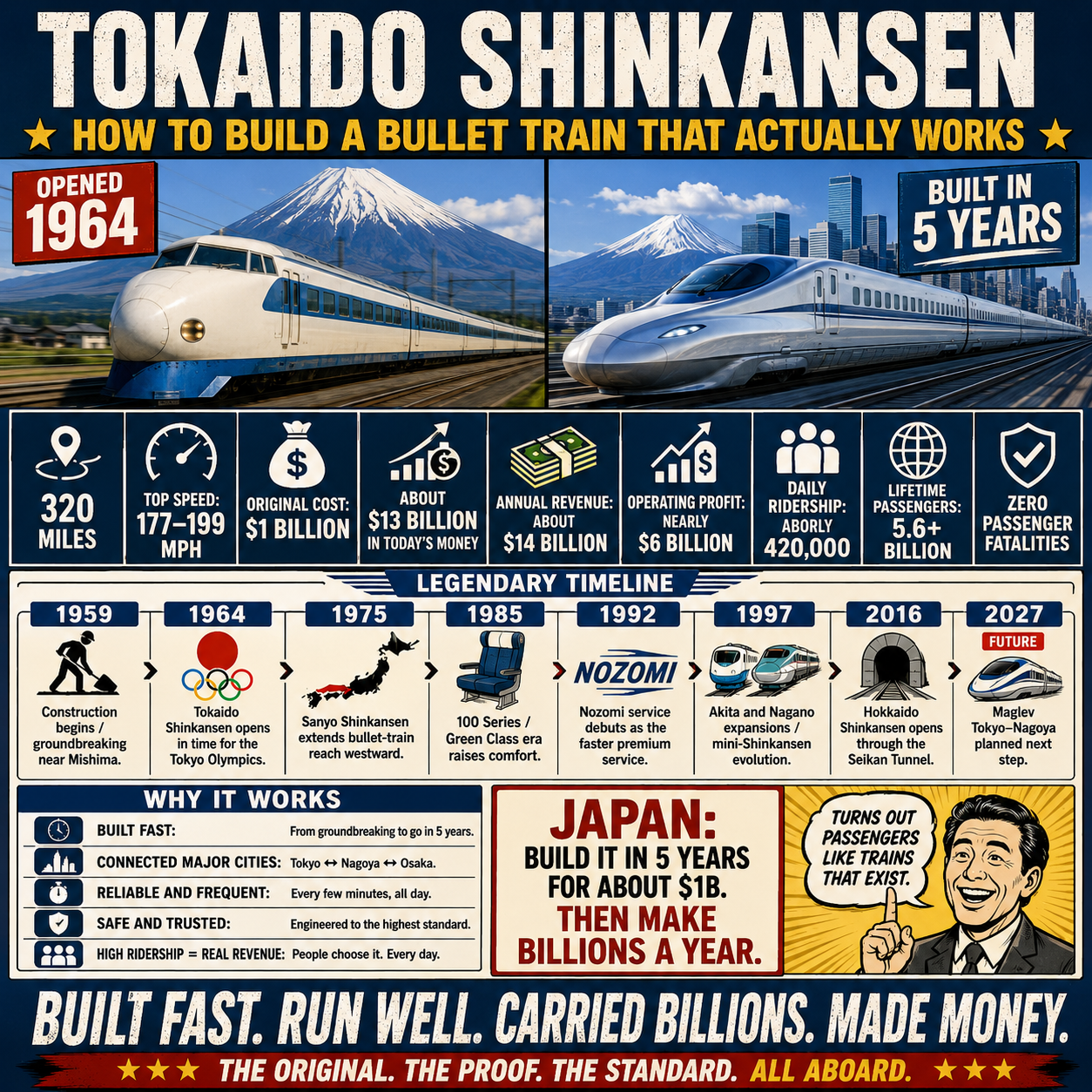
Japan was the first to get it right. Way back in 1959 the Japanese government committed roughly $1 billion to build the 320-mile Tokaido Shinkansen from Tokyo to Osaka, opening it in 1964 for the Tokyo Olympics — five years, for what amounts to $13 billion today. JR Central — the private company operating the line — now reports $14 billion in annual revenue and nearly $6 billion in operating profit. Daily ridership has gone from 61,000 in 1964 to 420,000 today. More than 5.6 billion passengers carried in its lifetime, zero fatalities — in a country more earthquake-prone than California. Built in five years. Profitable for decades. Privately operated.
France's TGV launched Paris-Lyon service in 1981, 265 miles for $4.8 billion. China built 819 miles Beijing-to-Shanghai in just over three years, opening in 2011 for $32.5 billion — longer than California's proposed route, on time and on budget, for less than what California has already burned without a single mile of high-speed track. Germany and Spain opened their first lines in 1992. Every one of those countries built their systems, ran their trains, and carried their passengers. They just got 'er done.
AMERICA USED TO GET 'ER DONE TOO
Read "Cadillac Desert." It covers the waterscape of the entire American West — Mulholland's long con on the Owens Valley, Hoover Dam and the Colorado River Compact, the Central Valley Project, Grand Coulee Dam, the never-ending war between the Bureau of Reclamation and the Army Corps of Engineers. Two agencies that out-dammed each other for decades not because the projects made sense but because congressmen traded votes and bureaucrats needed to feed their empires. Read it and you'll never look at a California almond orchard or the Las Vegas Strip or eat a strawberry the same way again.
Hoover Dam is the gold standard: fixed-price contract, 1931, $48.8 million — roughly $1 billion in today's dollars. Finished ahead of schedule, under budget. A 726-foot concrete gravity-arch dam creating Lake Mead, the largest reservoir in the US, holding 29 million acre-feet — 9.45 trillion gallons — and generating 4.5 billion kilowatt-hours of hydroelectric power annually. Economic impact in the trillions.
And then there's this: between 1863 and 1869 — six years — American workers drove 1,912 miles of railroad track from the Missouri River to San Francisco Bay, punching through the Rockies and over the Sierra Nevada using hand tools, black powder, and the muscle of Chinese and Irish immigrant laborers, for a total cost of roughly $50 million — about $1.3 billion in today's money.
The country that spiked nearly 2,000 miles of transcontinental railroad in six years for $1.3 billion in modern dollars may never connect Los Angeles to San Francisco in six decades for less than $231 billion. Something has gone badly, fundamentally, almost cosmically wrong with our ability to build things.
HAWAII MESSED IT UP TOO
Driving back from Mariposa by way of Los Banos (and the Espanas Southwest Bar and Grill - highly recommended), we saw exactly zero sign of the Bullet Train. Miles of production agriculture, traffic jams, road construction — but no Stonehenge, no track, no nothing.
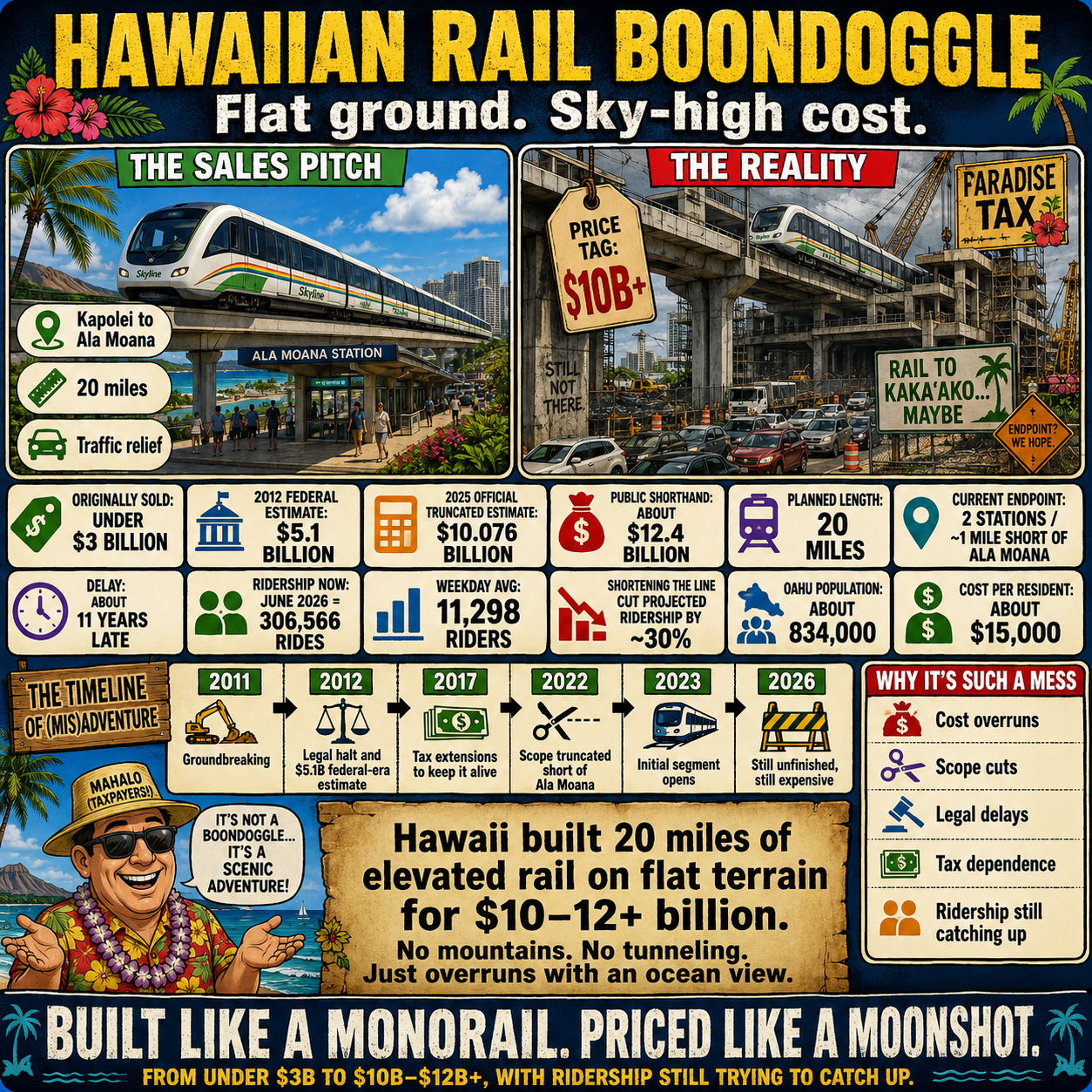
Which reminded me of the rail project that was causing choke problems on Oahu when I was there ten years ago — a line to some place in west Oahu that starts with a K - Kapolei, the Orange County of Oahu - to Ala Moana in the middle of Honolulu. Hawaii has a screwy way of going about things, so I asked Claude for an update on da kine.
Claude said “Shoots! The Honolulu Rail — officially called Skyline — is arguably the greatest per-capita transit boondoggle in American history.
Originally projected at under $3 billion, costs ballooned to $12.4 billion for a 20-mile line that is eleven years late. That works out to roughly $15,000 per Oahu resident — the highest cost per capita of any rail transit line ever built in the United States. To cut costs, the city eliminated two stations and shortened the line, ending in Kaka'ako instead of Ala Moana — reducing projected ridership by 30%. The revenue from a decades-long excise tax increase isn't keeping up with mounting costs.
Hawaii built 20 miles of elevated rail on flat terrain — no mountains, no tunneling — on an island of 834,000 people, for $13 billion, eleven years late. California wants to build 494 miles through mountains, valleys, and some of the most valuable farmland on earth. Good luck with that.
BRIGHTLINE WEST TO LAS VEGAS IS A GO GO!
There is one ray of hope: Brightline West — 218 miles, Las Vegas to Rancho Cucamonga, following I-15 through desert and scrub, no tunneling, no walnut groves, no dairy farms — designed to run 200 mph for roughly $21.5 billion, targeting late 2029.
Build that first. See if people use it. If it doesn't make a dollar, put a bullet through the Bullet Train and stop throwing good money after bad.
DON'T PUNISH THE PRODUCTIVE

Too late for the Bullet Train. But looking ahead — what about the Billionaire Tax?
The 2026 California Billionaire Tax Act was filed October 22, 2025 by SEIU-UHW — the Service Employees International Union-United Healthcare Workers West — directly in response to federal cuts in Medicaid and food assistance under Trump. A one-time 5% levy on the worldwide net worth of California's approximately 200 billionaires, projected to raise $20 billion. Revenue goes 90% to healthcare, 10% to education and food assistance. California has 12% of the US population but 27% of all US billionaire wealth — 213 listed billionaires with a combined net worth of $2.2 trillion. Critics call it unconstitutional and unenforceable. Six known billionaires already left the state before the eligibility deadline, taking an estimated $26.7 billion in potential tax revenue with them.
And we're out of time. Stay tuned for Part Two: Don't Punish the Productive. Hopefully they'll let me back on NextDoor — I was mining some good information nuggets before I got banned. Twice in three days.